Showing posts with label Tom Newsom. Show all posts

21 April 2016

Why You Should Be Watching... Line of Duty


Words by Tom Newsom

  • It’s not your usual police show. It’s more of a police procedural, only the investigation is against a police officer, with the team trying to outsmart them and prove that they are corrupt. Psychological mystery meets action thriller, you could say, only a lot of it is set in an office. In the first series, this meant one of the team going undercover to see what his colleagues thought of him, trying to uncover and prove the dodgy dealings and secrets, but doing it by the book. For all its chases, stunts and action standoffs, some of its most effective, thrilling scenes are the interview scenes - simply two or three officers against the person (plus their solicitor), but these are lengthy scenes, sometimes up to ten to fifteen minutes, full of verbal sparring and bending of the truth.
  • It’s realistic - sort of. These now famous interview scenes are full of realistic touches. Evidence is always in the form of numbered documents, movements are noted ‘for the tape’, arcane legal jargon is spouted, and quite often the phrase “I request the right to be interviewed by an officer at least one rank superior”. It sounds fussy, much of it is underplayed. Often this means people will jump in and target certain points to say that the show is not realistic, and that some scenes would definitely not happen in a real life investigation. So why have these touches at all - as verisimilitude, for the sake of it? Well, it’s certainly trying to be realistic, as a medical drama would be, say. At the time of the first series they couldn’t get the police to advise on the series, presumably as a show that investigated corrupt police officers would put them in a bad light either way - so they had to find other ways around it. In terms of the world that the show creates, it is meant to feel ordered, solid, realistic. Besides, anybody who disagrees with it because it doesn’t represent the real world should be pointed to a big glowing sign saying that this is TV, live with it.
  • It’s a hit. We’re now up to the third series. The last series hit the headlines, the first run in 2012 broke ratings records for the channel. It hit the ground running, and for good reason - the style of the show hasn’t changed since, keeping the same assured tone.
  • It’s not about the main characters. It’s worth comparing to that other big hit thriller of late, Happy Valley, because the two are doing very different things. That show is more of a personal journey with its characters, where the highlights are the achingly true dramatic moments, even when there’s a crime committed. Line of Duty is doing the opposite - there’s not even a central character or hero, and the private lives of the team that occur throughout the series barely get a look in. Even though they’re not the most interesting thing about it, they are great creations, much of this being down to the regular actors breathing life into every scene. Away from them, the series is built around a change in guest cast as they tackle each case each series - top actors coming in to give it their all. But even they’re at mercy to the fast moving, fast adjusting plot.
  • There’s a lot to catch up with. What appears to be self contained series, throwing out the plot each season for a new one, has turned it something more ongoing. So the question of jumping in fresh at Series 3 - it’s tricky, if not impossible, and there are moments that you will miss out on (also the first episode is soon to run out on iPlayer before the series ends). It’s a funny point, because most episodes makes you feel like you’ve missed something, even if you have seen every minute. After the long opening recaps (like The Killing had), that’s it - they may refer to characters and plots from previous episodes that you hardly noticed, or even the previous series, an impressive two years on if you watch it live - a feat of memory. Based around a series where nobody quite knows the full picture anyway, you can forgive the general lack of exposition!
  • It’s big, bold storytelling. It’s all about the investigation and the all important twists. And unlike some TV shows, here the twists actually change the entire show from episode to episode. It all feels very solid, even when you can’t quite make sense of it - there’s no cheating, nothing too overblown either. That’s part of what makes it so great to watch weekly, is the way it rug-pulls almost every episode and casts everything in a new light, in only a few scenes or gestures. Each episode is made very tense through editing and music, and there’s been some huge cliffhangers, making them a ‘must see’ every week. It’s the way forward, or perhaps a throwback - a boldness of storytelling that is matched by a level of research and detail and thought. It is TV with a kick up the arse.

18 April 2016

Film Review: High-Rise


Review written by Tom Newsom

The most incredible thing about the film High-Rise is that I ever managed to see it in the cinema at all. I had been looking forward to it for months, the project catching my attention back when it was being filmed. But I wasn’t able to pin down a trip to a cinema miles away when it was released back in March. A delayed, limited release at my local cinema has meant I was able to finally go. But not before more than one friend had seen it, and both independently had hated it, with one declaring it “the worst film I have ever seen”.

So of course, that meant I had to go and see it for myself. And I noted afterwards, in the small screening I was in, two people walked out halfway through. Not me though, I loved it, more than I should have done.

I’ve seen Ben Wheatley’s previous two films Sightseers and A Field in England - of which this film feels a piece with - in addition to this work on Doctor Who in 2014. (I’m not itching to see previous film Kill List, I have to say, as it’s meant to be terrifically scary). He has set himself out as a new breed of auteur - or auteurs, working in partnership with screenwriter and co-editor Amy Jump, who has also written, and somehow adapted, High-Rise.

It may have bigger visuals, and a bigger cast and budget than his previous, but it definitely feels like a Ben Wheatley film - a particular strain of darkness, immediately apparent in the first few minutes of the film. It’s blackly comic, often quite funny, with shocks that should hopefully fill you with awe, rather than disgust, and a bold explanation of thematic territory.

It’s adapted from a novel by JG Ballard, an author whose style feels like a perfect fit. It’s dystopian, a sort of science fiction, linking together the darker sides of human nature with the bright new tower block accommodations. The masterstroke with this film was setting it not in a shiny, non-specific future, but in the mid 1970s. It resonates in every aspect of the finished film - it’s incredibly stylish, decadent; the architecture is perfectly bleak and brutalist, and the residents’ trip into barbarism is recognisably, comfortably signposted by the excesses of history - the sexism and hyper masculinity, the flowing alcohol and dissatisfied workers. And, of course, the British class system, which is at the core of the plot: upper class at the top of the skyscraper, lower class down below, arguments and snobbery in the contained space leads to chaos. Setting it in the past makes it less overtly political and easier to swallow, allowing the high style and increasing absurdity.

There is so much in this film to love. The visuals stand out - they usually do for me - not just the style of the design, or Laurie Rose’s high art cinematography, but also the outstanding practical and visual FX on the film, some of the best I’ve seen (the menacing tower itself, the soon to be infamous shot of a head getting dissected). The cast list is amazing, led by Tom Hiddleston’s composed maniac everyman, but a real ensemble. The direction is spot on tonally; the production is quite something considering the scope of the film. The editing is sometimes ambitious in its rhythmic cutting between scenes, but is often invisible. The music felt sparser but vital. It’s a film world to lose yourself in.

As the characters delve deep into the mad, the narrative appears to lose its way also. The ending lacks the focus it needs to be truly satisfying. It’s as if there’s glimpses of a strong plot in there, but it’s buried under the opaque, time (and geography) shifting editing. I could see why some people would come away thinking the film was terrible - for those who didn’t enjoy it, who didn’t get sucked into the film’s hypnotic spell, a more descriptive word would be nonsensical, perhaps even pointless. And that’s aside from the sex and language and increasing violence.

This disconnect is well expressed for me by a sequence which acts as the turning point of the chaos, a frenzied montage of shots, bridging the descent into madness of the central characters. It repeats images from before, whilst leaping forward to the point in time where the residents’ savagery has escalated to even more creative levels. At this stage, the film will either convince or it will leave you way, way behind - as it bridges the huge leap of disbelief suspending required. Have all these people stopped going to their day jobs? Why hasn’t everyone just left? From this point, I found it best to forget the logic.

Even if the film isn’t totally successful, it’s definitely highly memorable - quotable, visual, faintly shocking too. I’ve got no clue how successful an afterlife this film will have - critics’ reviews have been mixed but generally praiseworthy - but it’s definitely a film you should seek out and experience.

04 March 2016

Why You Should Be Watching... The Night Manager


Words by Tom Newsom

The first thing that strikes you is the sheer class coming out of your screen. Not just in the cast (Tom Hiddleston, Hugh Laurie, Olivia Colman, Tom Hollander... why aren’t you watching it yet?) but it’s in the production values, the large budget, the sweeping helicopters and locations and stunts. It’s gripping TV, on a Sunday night on BBC One of all places.

The opening titles is a feast of imagery from hotels and weaponry, giving you a strong indication of the plot to come, and then we get to the five star hotel itself, where our sharp suited hero meets a glamorous woman guest and oh lord it’s like James Bond isn’t it?

The Night Manager is based a book by John Le Carré, who as far as I know has never tried to imitate James Bond. The show is almost a reply to the recent Bond films, almost as Le Carré’s famous George Smiley and Cold War-set novels were an antidote to the unrealistic, uninvolved spy stories of the Sixties and before. Here we have a British - almost too British - ordinary man, Jonathan Pine, dealing with the real pressures and consequences of spying; with a realistic, filthy rich bad guy in Hugh Laurie’s ‘Dicky’ Roper, the arms dealer, who’s not as one-sided as you’d expect either. Plus there’s the obvious point of main man Pine’s attraction and respect of women. Buried in the layers of character that are built up gradually, you get the impression that his motives are based on politeness, decency - yes, almost too British here.

And of course, no car chases, at least not yet. Currently two episodes in, I personally was surprised how vast the plot was, though more accessible and pleasingly streamlined than some other John Le Carré I’ve seen - this is a thriller in every sense. It takes unexpected turns - not knowing anything at all about it, I didn’t know where it was going, and it’s most probably better that way. And I found the second episode a very different tone to the first, as we go deeper into the story. It certainly looks like it will use its six hour running time very wisely, offering us a real assortment of locations - Switzerland, London, Mallorca, Cairo. The last one - partly setting the story in real events, just in the 2011 uprising, makes it feel bold and bang up to date, like the production itself. However the original book was published twenty five years ago; from interviewers with the screenwriter and director, it appears that they’ve made some important changes, although some of these were suggested by Le Carré himself when they met with him!

That director being notable, award winning Danish film director Susanne Bier, and screenwriter of Hanna and Spooks alumni (sit up straight, Spooks fans) David Farr. It’s an BBC/AMC co-production, its attracted top drawer talent even to the minor parts (David Harewood!) and those rare to TV. Tom Hiddleston makes an obvious smooth hero, but Hugh Laurie as the worst man in the world is fantastic. There’s your reason to watch right there.

Words by Tom Newsom

13 January 2016

TV Review: Jericho Episode One


Review by Tom Newsom

New Year, new telly, and a brand new contender for Downton Abbey’s old crown. It’s been billed as a “Yorkshire Western”, which is a great idea in itself. Then I heard it’s also backed up by real history (workers building the viaduct for the railways), which proves even more interesting, a sort of alternative Victorian history that shakes up the usual costume drama route.

It’s a brave move then, for ITV to make it, and hire Steve “Sherlock and Doctor Who” Thompson - a good writer, but you really need an amazing one to pull off the script that this is crying out for. What story there was seemed ridiculously oversimplified, and barely scraped the sides of the glacial one hour running time (in a ninety minute slot - short changed even by ITV’s standards).

Instead of plot then, the focus was on scene-setting. The scenery is plain - wooden huts on moorland - but adds to the Western atmosphere, and the community just about feels realistic, given the large amount of extras. The cast is onto a good thing - Sophie Thompson, Lorraine Ashbourne, Mark Addy as a detective - a tour of the North, ITV style. Jessica Raine and Clarke Peters stand out as the leads, because they’ve been given the meatiest roles in this, which is saying something. Jessica Raine’s character is a resourceful, Victorian-feisty mother, trapped in a corset and an eight episode contract; Clarke Peters doesn’t do or say an awful lot, much like the other ‘regulars’. All of the characters seem to drift through the episode, and by the end of it, you’re left with little clue as to how the events will affect the characters in future, or what it all really means.

And it’s so very ITV. There’s a moment where the big event in the episode happens - only one, you can’t miss it - and when we get there, everybody switches into Saying Exactly What They Mean, until the end of the episode. It would be passable if the whole thing didn’t feel so deathly slow, or foreshadowed twenty minutes before. One of the characters said that “the viaduct’s finished” - I hoped this meant that the series was over, rather than just their Victorian Business Plan going wrong. There’s also a death, at night, which the series will pivot around - but the scene and the sudden sight of blood just felt misjudged rather than edgy, as if somebody had pasted it in from another production.

It really isn’t the idea itself though, it’s in the writing and handling of it. There are plenty of counterparts that I’ve enjoyed in the last couple of years: Peter Moffat’s great series The Village told rural themed stories also in Yorkshire, going from a child’s eye view, to people going off to the World War, and the more hopeful years following. Sarah Phelps wrote about a field hospital in the War in The Crimson Field, almost a Western in its community fighting for survival, and interconnecting interesting class-based characters in an era of change. John Fay created The Mill, which showed the lives of the poorest Victorians with all of their slang and accents and cheek and fighting for employment rights. Yes, all three of these needed time to build up their worlds and characters. But they also felt, on screen, that far more love and care had been taken. This episode reminded me of the first one of Mr Selfridge (the only one I’ve seen), an increasingly ludicrous checklist of a drama.

The music got to me too, in the end. It goes full on Western in places, never letting you forget what this outpost is meant to stand for. But the tone was too chipper and lively for... what? Are we meant to see these people as poor, hard-bitten, on the edge of society? Or people coming together in a heart-warming tale of survival? It's hard to tell if these people are meant to represent outlaws or pioneers or whatever. Really, it felt as dangerous as a leisurely stroll down the high street - and people die in this!

It’s not unwatchable, just a completely uninteresting take on what was a promising concept.

05 January 2016

TV Review: And Then There Were None


Review by Tom Newsom

First of all, I’ve made a point of reading all of Agatha Christie’s output, and And Then There Were None was definitely one of my favourites. Less of a blessing and more of a curse - would this new TV adaptation be right up my street, or will I just pick up on all the changes they make? I wouldn’t be alone though - it’s the world’s biggest selling mystery novel at over 100 million copies apparently - a very strong 8 million people watched this one.

For fans of the book, I think they got the tone about right, which is a trickier task than it appears. When I read it, the sense of dread was there from the off in the careful plot construction, rather than the fairly ordinary prose. Then the danger escalated as one-by-one, people started dying. It was a scary book - I think I read it at Halloween coincidentally, but it certainly fits that mood. Rightfully they emphasise this on TV, though they come close to overdoing it. It’s a tense watch from the off, but where do you go from those opening moments of dread?

The story becomes bloodier (and swearier) in later parts, as the tone turns more primal and brutal. It’s what stands out as modern - yes, the book goes from civility to barbarity in a few hundred pages, but this one starts out with barbarity (a little more civility would have helped) and goes even further than the book. The choice additions made a few headlines in certain tabloids - drug taking, F-bombs, grisly murders - but it didn’t take me out of the story, instead, the opposite.

There’s a dark heart I’ve been trying to avoid so far in my review - and it’s not the ending (that was brilliantly done, a faithful recreation of the book). No, it’s the running time - three parts, three hours long in total. Oo-err. Chopping any story into three is sacrilege enough, although by construction this one is pretty well suited to it - and when it’s shown over three consecutive nights at Christmas, it almost rolls into one anyway.

But oh lord, there’s really not enough plot to go round. As such, it’s very slow. Most of the first part is set-up, the other two parts end up being a bit baggy, really. It’s very tense - it’s a miracle it’s still tense when nothing much is happening - but I still feel like there’s an absolute knockout two (easily, two and a half) hour version in here, struggling to get out. Maybe that’s because I knew already what was going to happen next.

It makes for an interesting watch though. No spoilers here, but the writer, Sarah Phelps, has put in a lot more clues for the TV viewers to pick up on, which makes it more rewarding than the rather too enigmatic book... if perhaps too easy to blindly guess the killer, as the people I viewed it with attested (though it’s a problem that’s in the book, made worse here). The script doesn’t rely on the same tension building tricks, but happily makes the ending easier to swallow.

Then there’s the cast. It’s a dream cast if ever I saw one - there’s ten juicy roles on offer here, so it attracts big names. What makes the thing work is that each person is distinguishable, a must when there’s a lot of characters to set up - thanks to casting, costumes, acting, writing. On the page it’s a lot of names, but they don’t matter - the story is visual.

It’s recommended then - hell, it’s the one of the best mysteries ever, and a story that’s sold out thousands of theatre performances since, of course it’s recommended! It’s a smart piece of TV, and a beautifully designed, modern 1939 (those jade green sculptures!). Just be wary of the slower moments, and enjoy the ride.

21 December 2015

Roundup: Doctor Who Series 9

Catch up on each of our reviews of 2015's Doctor Who episodes by clicking the icons below, and don't forget to check out Matt and Dave's overview of the whole series here.


+ You can also get all this year's rating figures here.
+ And read our readers' thoughts on the series here.

Thank you very much for reading along this year, and we'll be back next weekend with a review of The Husbands of River Song!

28 November 2015

Book Review: A Place Called Winter by Patrick Gale


Review by Tom Newsom

I’d first heard about this book on Radio 2’s Book Club - they were full of warm praise for it - in early 2015. And although by the time I came across it in my local library, it meant that I knew the shape of the plot and what to expect, it did not disappoint. It’s the sort of book where that doesn’t weaken it, where the journey is more important than the twists, although there are some big ones.

It’s all about a man, Harry Cane. The book’s early chapters trace his cosy life in Edwardian England, from his early age to marriage and family responsibilities, before everything changes. We’re under his skin for most of this book, for he’s a character who never quite fits in anywhere, even though he tries - not in formal society, nor in the vast prairies of Canada, where he is forced to escape to. Even though the landscape changes vastly, the book doesn’t lose its footing - now he’s got even more to learn to become a farmer and landowner, to fit in with the tiny rural communities he finds there, and importantly to discover himself.

One of the quotes on the back of my copy says it “manages to be both tender and epic”, which is a perfect description. It covers a lot of ground but we never lose sight of the main character and what it all means for him.

Whilst reading it I was wondering if I’d recommend it to anyone unreservedly. And whilst it’s a cracking, solid book, there are a few scenes of violence that means it’s not a comfortable read at times. But then it’s not a comfortable adventure - and whilst there are terrible events, the tone always allows an everyday humanity and a feeling of hope afterwards. If anything it’s a book about survivors.

You can sort of tell it’s based on a true story, very loosely: the main character’s background came from one of the author’s mysterious relatives, which he then breathed new life into their actions by creating a character. He’ll never know what they were really like, or why they relocated to Canada, but the motives here feel real. The whole book has the ring of truth; I think that’s down to the research, plus the level of detail that’s then put in the writing. It doesn’t proclaim its historical accuracy on every page, but due to the compressed, fast paced plot (some big time jumps), there’s a lot of scene setting, well told. It also makes it a great read, one of those books you can really lose yourself in.

The historical detail doesn’t stop at the world the author has created either - it’s present in the character’s heads and how they see themselves. As the writer has said - “The challenge was to inhabit a homosexual life in a time when there are no words to describe any of the things the character feels or does.” It’s no spoiler to say that you honestly don’t notice this linguistic, mental gap when you’re reading it, although it is very much there. This book feels like a story very much of its time, even if any story like it wouldn’t be told for over half a century later. And I think the secret strength to this book is the characters: if the world around them felt real, then they feel doubly so, rounded and authentic - they make the most realistic of mistakes.

It’s an exquisite book, full of foreboding, adventure and human truths. Well worth reading, and it will stay with you for some time after.


20 November 2015

TV Review: Unforgotten - Series 1


On paper, ITV's new crime drama should be a total disappointment, writes Tom Newsom, yet it's surprisingly engrossing and gets better as it goes along.

A new ITV crime drama - no wait, come back!

On the face of it, Unforgotten doesn’t have a lot to offer viewers. Yet another drama where police detectives investigate old crimes (there’s literally a new one every week), only this time there’s no twist with the main characters, nor is it set in a particular, photogenic location. To make things worse, ITV were hailing it as the next Broadchurch, and then Nicola Walker, the main star, pops up in BBC One’s much more experimental drama River in the same week.

Every sign pointed to this being a disappointment - that is, except the cast list, packed full of fine actors, almost laughably so given their individual screen time in the first episode. The list goes on and on, but the ensemble cast includes Trevor Eve, Bernard Hill, Sir Tom Courtenay, Ruth Sheen, Gemma Jones, Cherie Lunghi, David Troughton, Hannah Gordon, Peter Egan... it’s an impressive roll call to fit into 45 minutes and lends the show some serious star quality. All this is fine, but often it’s no indicator as to whether the show is any good; even the best actors suffer with bad material.

So it’s a great relief that Unforgotten - forgettable title - is one of the best dramas ITV have put out this year. Sure, it isn’t original, not on the face of it, not as a genre. But its strength is in its writing: it manages to pull off having a ‘realistic’ tone but also with big themes, solid drama and twists, with relying on a flashy style or narrative tricks.
If the large cast list doesn’t give it away, the production is big. There’s a real drive to make this a diverse series that captures life in the country today - it’s great to watch a show that has a disabled character, black and Asian characters, gay characters, and all kinds of older people - from lotharios to liars to people with dementia. There’s even, by the end of it, a birth, a wedding and a funeral. It doesn’t feel like box-ticking, nor as if ITV is trying to appeal to all. It’s more like a state-of-the-nation drama.

Not necessarily just a state of the nation today, either. In the series, the police uncover a body from 1976 - so each of the main suspects is now in their 60s. Cleverly the series doesn’t dwell on the specifics, nor overly rely on flashbacks, leaving the events shrouded in mystery until the final episode (after all, the characters can’t remember everything from 40 years ago!). At first it can feel annoying, later you realise it’s the way to make you keep watching. That, and how it doesn’t need to - the drama here is watching to see how these suspects cope when their pasts are looked into, and secrets uncovered.

What secrets! What storylines! One of the strongest, I thought, is what Ruth Sheen’s character goes through. Once the police come sniffing round, it all comes out: she used to be a racist, she tells her - black - husband of twenty-odd years. She was egged on by her former boyfriend, she wasn’t really like that. We rarely see a story like that on TV, I think. Not just attacks by faceless youths but the insidious hints and rumours - with the focus solely on the characters in the modern day, the shoe is on the other foot once her community finds out. In the end, she’s merely looking for trust and love, rather than full forgiveness.

Obviously there’s a theme of history repeating itself, that the truth will out. It’s also incredibly easy to see this as a reaction to the modern day’s judging of the 1970s - with some people picking it as a decade where what passed for everyday life are now serious crimes  (as opposed to every other decade before then, and since). It doesn’t feel like a coincidence, but it’s not entirely unsubtle. Nonetheless the crimes that the suspects are guilty of are well chosen - the full gamut of hate crime to underage affairs. But there’s always an element of doubt, as in the real world. Every criminal has a defence.

It’s this realistic tone, combined with a steady, balanced plot, which makes this drama so engrossing and deep. It gets richer as it goes along, right up to the ending, which did not disappoint. The dramatic storyline and twists only go some of the way - it’s what sticks in the mind later. This is the sort of drama where the characters - especially the police detectives - stop for a few minutes and discuss the nature of guilt, innocence and historical crimes. And this is in ITV. My kind of show.

Thankfully they’ve announced a second series - and unlike Broadchurch, it might actually deliver. The only things that need to carry over is the format and the detectives. I’ve barely said a word about Nicola Walker and Sanjeev Bhaskar - always likeable actors, both of them - and that’s probably because they’re not at the centre of this. I could barely tell you anything about their characters, nor do they go through much development by the end of it. Almost as if it’s real life. These are people you’d happily watch another series with, solving further long-buried crimes, which makes it good casting. That, and the top names, make this sound more like Midsomer Murders. But this has real teeth.

Oh and the theme's tune also pretty good.

15 November 2015

Doctor Who: Sleep No More


Sleep No More isn't trying to say or do anything in particular, it's just an experiment into uncharted territory for Doctor Who - but it doesn't work, writes Tom Newsom.

I’m sure some people must love it, but I never hear anyone admit that in public. The ‘found footage’ genre, normally for low-budget horror, has been ubiquitous in the last five (ten? fifteen?) years. I’m not an expert in it by any means, but it offers a very different form of drama to the one we’re used to in Doctor Who - something more distant. However given its widespread use, doesn’t it feel like a great fit for a scary episode? In theory, perhaps - but here it just left me cold.

You can’t call this episode conventional, in any sense. But I’ve surprised myself, thinking back, how many things it gets spot on: the monsters especially. Sleep, the sandman, it’s an irresistible connection, played to its full here. But the camera moving means that we barely glimpse them at first - a plus for anything trying to scare us. And then when we see more, it’s just a deformed blob with legs and a gaping mouth - eurgh. They’ve got one of the sketchiest backstories and behaviour - “sleep dust” is all there is to them - but they don’t half scare.

It’s a great production, especially when you consider it was filmed with the normal HD cameras, as opposed to smaller models attached to the actors. The camerawork can really make you feel the action even when people are standing still, and the editing is faster. Parts of this episode are INTENSE, the scary parts, which you don’t normally get with Doctor Who.

It’s definitely an episode that will be rated a ‘12’, in a series that’s had at least four of them so far - so god knows what young children thought of it. I remember being scared watching Jeopardy, a CBBC Blair Witch Project-style series, when I was younger - and that was just kids in a field with cameras, rather than full-blown Aliens.

But there’s only that intensity to parts of it. For the rest of it, normally the talky scenes such as at the start or with the supporting characters, it starts to grate. Yes, really - Doctor Who is a programme that actively tries to not be boring, always. But when it’s a group of guest characters who you barely even recognise (let alone care for), who are muttering in wide-shots with shaking cameras - well, you pray for a good closeup. Thankfully we get a few, of the Doctor especially (him and Clara are a welcome presence this week), because otherwise you’d struggle to feel a part of the action, even with the point-of-view business. At some moments it didn’t feel like television to me at all, more like a first-person shooter - really, for Doctor Who?

The helmet cameras, or lack of, was a good twist though, in an episode that had more standout moments than it deserved. The plot is involved just enough, building up and teasing out a few mysteries. Okay, I felt good about wondering to myself why we were seeing things from Clara’s point of view (or whether there was another soldier character I’d missed). The story about the Morpheus process was well told too, with its slightly creepy set-up involving “that song”. Less so about the hunt for the villain behind the piece - by then I was confused what the overall monster plan was, though so was the Doctor.

It would be cruel to sign off a review with the Doctor’s closing comment - “none of this makes any sense!” - so I won’t. Instead, I’ll highlight the cool and utterly terrifying closing shot of Reece Shearsmith. Good to have him in Doctor Who, and a perfect fit for this particular part. This episode feels like an Inside No 9 on BBC Two, if its budget was tripled overnight.

Really though, this is Doctor Who (and writer/horror fan Mark Gatiss) having fun with a particular genre. You can tell that through the ways they’ve tied it into the story - the ‘found footage’ of the “cameras”, and the message that frames the story. It’s not like a film, in that the director is using it to make a statement or a higher art-form. This is purely them trying new things, an experiment of an episode for this week’s audience.

I’m just not quite sure it works.

14 November 2015

TV Review: London Spy - Lullaby


The first episode of BBC Two's new drama portrays it as more of a romantic mystery than a traditional spy thriller and is full of clever little touches, writes Tom Newsom.

You have to suspend your disbelief, even in the opening scenes. Ben Whishaw is entering a gay club - we know this because it’s populated by 90% men and 9% Donna Summer - yet none of the crowd recognises him. C’mon guys - this is big name casting! Q, Paddington! Star of the excellent drama The Hour! An exceptionally busy actor at the moment. But we’re not interested about the crowd, just about him, Danny. He leaves, much later, still high, and walks out into the shadow of the MI6 building. If that doesn’t set up the episode perfectly, I don’t know what does.

He meets Joe on the bridge and straight away from their slightly off behaviour we know that these two characters aren’t trying to emulate real people. Danny is awkward and says too much, the mysterious Joe stares, wipes some sweat from his face and gives him his water pack for free. I’m assuming here that encounters in the middle of London at five in the morning aren’t quite so homoerotic - but I don’t know.

If that didn’t feel real enough, then happily the rest of the drama does. They fall in love in a way that is rarely seen on TV - slowly, after they’ve met each other a few times and spent time in each others’ company (long walks, mumbling, endearingly cute groyne walking). The script specifies it’s over the course of weeks and months and actually yes, we feel that too. It’s as slow as relationships in costume dramas, even in an age where romantic opportunities are no longer limited to endless formal dancing.

So, it’s slow - but gripping, always gripping. The writer, Tom Rob Smith, is new to TV at least, and he’s very lucky that he teamed up with this director, Jakob Verbruggen. I honestly don’t think that any other director working in TV could have handled it this smoothly or brilliantly. I really enjoyed his work leading on the Gillian Anderson BBC Two drama The Fall and this is in the same mould, as a first episode at least: following only a few characters before the main conspiracy and drive steps in. It’s mainstream (read: actually watchable) minimalist. Indeed, this episode revolves around just three people, who thankfully are really good actors. Phew. And it earns its length: there’s an electric scene, one of Ben Whishaw’s best ever, in which he opens up and reveals some of his past. The writing is spot on too, but played slowly, in one take, gives it intensity and the extra time makes you read beyond the more subtle words and realise the importance of it.

It’s billed as a “spy thriller”, but it’s neither the high action of SPECTRE or even Spooks, nor the twisted logic of Tinker Tailor Soldier Spy. Instead this episode is more like a “romantic mystery”. But there are spy elements if you’re a fan, in an episode full of small, clever touches - the hidden secrets, shadowy figures bugging and tailing you, hints of a greater force at work. It means that there are rules that we can expect, even though we’re not quite in that genre yet.

Other plot points appear to have been inspired by events in the news... I won’t say which events, however, because I felt that the plot was spoilt after I read a headline in a TV mag explaining it. The less you know the better - especially when there’s so little “action” that the trailers on TV midweek probably show you everything that happens anyway.

The promotion and trailers, Ben Whishaw’s presence, plus coming so soon after his role in the new James Bond film - well, it was going to be a hit, and it is - over three million viewers. For the first episode at least - less people will watch it by the end, as with Wolf Hall and every other drama on the channel. Not because of the central romance between two men (surprisingly rare to make a series around it - I always forget this) - but because this type of TV has a very particular style and pace, which this episode achieves beautifully.


25 October 2015

Doctor Who: The Woman Who Lived


Review by Tom Newsom

The second in a two-part story - or is it? Regardless, it’s one of those uncommon episodes of the show - one where characters and themes and messages take over an otherwise standard plot, this time with magical results.

At first you might think you’d skipped an episode, what with the sudden change in setting. But this one complements last week’s “opening” part to the story rather more closely than you’d expect. The action-adventure strand in both is slight, but there are big discussions on life and death. Bravely, this episode is for the first half a lengthy two hander (no Clara!), before the action widens out. It’s great to have a smaller episode that still manages to be very compelling - I was captivated.

Much of it’s down to Maisie Williams’s character - what a part! The range is extraordinary - going from Viking girl last week to seventeenth century woman... probably because it’s basically two separate characters. It’s an inherent weakness that this episode doesn’t naturally follow on, and that’s the point. The character of Ashildr has grown up, hundreds of years older, and can’t even remember when she was born. Her morals have changed beyond recognition - as has her style! - and she’s become an interesting, headstrong figure who has run away from her past.

Oh, but it’s here where the best, deepest part of the episode is. Ashildr’s assumption that the Doctor has come back especially is undercut by the alien artefact plot; she’s just a coincidence, and plenty of adventures have happened since. But the Doctor’s well-meaning gift of an second “immortality charge” incase she meets someone she likes is undercut by the reality- she’s immortal, she doesn’t get close to anyone and she’s only got one patch; as she says, simply, “nobody’s good enough”. There’s plenty of touches here, quickly told to us - her mastering every skill through being alive longer; her disregard for her own species coinciding with becoming a highwayman; seeing her life through history culminating in tragic loss.

And then there are the parallels between her and the Doctor - it’s not particularly subtle by the end of the episode, but it makes the whole thing sing. The Doctor is advising Ashildr to notice the little people, the “mayflies”, an about turn perhaps from last year into the Doctor we know and love. He admits, though, he hasn’t made Clara immortal in the same way, even though he’s said he won’t bear to lose her. It all adds to the foreboding mood this series.

It’s a very handsome Doctor Who episode, thanks to some great imagery from the script (picking a very fancy period of history, and adding in a big kingly lion too). It looks stylish, with the night-time scenes lit blue with orange candles reminding me of Poldark’s house style, by the same director. But it’s not just the look - combined with the previous episode, Ed Bazalgette has managed to produce the ultimate Who calling card, with two perfectly paced adventures (in my opinion), telling a story on a grand scale.

The plots in both this and last week’s were admittedly slight - or simply a foreground to a wider canvas of the immortal, eponymous Ashildr. Leandro the Lion is both a cool monster and a fearsome foe, though his purpose sticks out more obvious than most this week - to provide a test of Ashildr’s character, as well as the obligatory monster of the week. He keeps to the shadows (unfortunately -the make-up is nice), and gets about as much screen-time in the end as the controversial Sam Swift the highwayman. I like Rufus Hound, and I like a rude joke as much as the next man - but I expect the “gallows humour” scenes will get some stick, in an otherwise grown-up episode. Personally I found it the best kind of silly jokes, even if it all goes on a bit too long, necessary to lighten the mood, with a performance containing all that sadness behind the humour.

If it invites comparison to Doctor Who of old - not that every episode does - then Enlightenment jumped out at me, and not just because it’s one of the increasingly rare examples of a TV episode written by a woman. Both are different from the normal stories the show tells, and curiously they both end up mixing poetic, immortal characters with history and aliens. Not that poetry and big ideas is limited to those two - look at Warriors’ Gate, Kinda, or Survival, or Vincent and the Doctor, Kill the Moon or In the Forest of the Night. The Woman Who Lived is one of those rarefied, unusual slices of Doctor Who that works on both levels - as a family adventure and a sweeping, engaging drama.

At the end, we have Maisie Williams - a very successful, commanding performance, even when it’s hyped beforehand - joining the pantheon of potentially recurring Doctor Who characters, and an immortal one at that. The sorts of people he considers to be his friends, who can pop up whenever and wherever the writer wants - Moffat’s a fan, of course. I didn’t quite buy the rather Torchwood-esque group Ashildr was going to set up, nor do I think it will be returned to any time soon. Because one of the clever things about the show, is that in following episodes, if a writer wants to feature her again, they don’t have to stick to the established events at all. Like the Doctor, the show can write its own history as it goes. Whether this episode sinks or swims in that history remains to be seen.

18 October 2015

Doctor Who: The Girl Who Died


In terms of eye-catching imagery, this one grabs your attention. “Doctor Who meets Game of Thrones!” says the Radio Times (slightly superficially, given the actual episode). “Vikings Vs Aliens!” cries another. And if you’re thinking that it sounds fairly typical for the series, this story takes a simpler plot, tells it well, and makes good use of the extra room for smaller, snappier scenes. After the spooky but rather scientific investigations of Under the Lake, I liked this one even more. It’s my kind of Doctor Who.

It’s also yet another take on an established genre. No, not Vikings, but the classic, Western movie trope of a village being under siege and having to train up the villagers to beat the invaders. Not that it’s the first time it’s been used in Doctor Who. Having the Doctor gatecrash another type of story is one of the show’s staples, as it allows everyone to have some fun, and it’s the only type of show that can get away with it so often. This episode has some fun with it, with the Doctor training up the villagers and doing his best army general impression. But mostly, it’s played for real. He knows full well that the villagers are going to die (he argues they have to die, using his logic, because otherwise it will cause too many ‘ripples’ in time). The odds are against him more than ever in this impossible situation.

If that sounds less action packed than most stories, you’d be right. The story breezes along rather nicely, with some steady direction. After a fast paced introduction where we’re (very) speedily thrown into the situation this week, the story settles down into... introspection. The Doctor isn’t a fighter - actually, there’s very little fighting in this story at all! - he’s a thinker. And when the enjoyable and especially funny quips die down, there’s a rare chance for the show to delve a bit deeper into the characters than they usually do in recent years. Or have the Doctor and Clara talk about weightier issues.

The standout emotional scene in the middle of the story is the Doctor ‘talking’ baby. It’s taking what was presented as a joke from previous episodes, and perhaps being inspired by Peter Capaldi translating the dinosaur in Deep Breath too. The sound of a baby crying alone didn’t work in sparking the village into action, so the Doctor translates it into language and it becomes sweet and sad and a glimpse into an unknown world. All of this in a few spoken lines - and it’s enough of a moment to hang the rest of the story onto it.

I feel sorry for the new aliens, though. The Mire look and sound pretty cool, and the design does a lot of the work for them. But they don’t get much of an outing in this episode, when most of it is devoted to the Doctor and Clara. Pitching them as Viking-like in morality makes them stand out from the rest of the show’s pantheon straight away, even though we know very little about them otherwise.

The episode strives to be entertaining, with the Doctor on fine form. This week Peter Capaldi is cast as a mad god and a rational thinker rolled into one, and a goofier side to some of his humour. As ever, he feels unpredictable - hell, this Doctor feels like Tom Baker, having that alien aloofness of not caring for human matters, masking the love of the trivial, and deep friendship with his companion. Clara, you could say, occupies some of the more traditional role as she’s becoming more like him - she can stand up to the aliens too. But also she’s definitely got that shared bond with the Doctor as they understand each other much better. (All the more important to keep those talky scenes rather than reduce it all to shorthand)

It’s Doctor Who on strong form - reminiscent in broad terms of last year’s Robot of Sherwood (down to some of the expansive sets and the sunny look), but even more successful, if a more sketchier drawn setting. The Viking setting is a catchy look, but populated with everyday characters, with more detail being sketched in with new girl Ashildr. She’s cleverly played as just a normal, quiet young girl, but cleverly written to make her more Viking and less modern and immediately likeable. Her strengths are slowly revealed, and they are in her character rather than in her funny quips: her heart, her storytelling, her innocence. It’s a good role to build a story around.

For all the build-up to this particular episode, overthinking fans might feel a bit underwhelmed by the result. Sure, Maisie Williams’s casting is exciting, even when you discount the theories as to her character - cue the inevitable list of old friends and foes. But the episode itself (titled The Girl Who Died!) acknowledges that her character will be important right from the start, even if it cheekily puts the Doctor’s interest in her down to a premonition - “remembering in the wrong order”. Looking back, it’s pure mystical foreshadowing, but at least we can be comforted in the knowledge of another 45 minutes continuing the story next week.

27 September 2015

Doctor Who: The Witch's Familiar


Review by Tom Newsom

Doctor Who has legendary stories, those images and scenes that have lasted long in the memory. The sort of thing that’s talked about in the playground, or reiterated in fan publications (icon or not): Daleks invading London, Cybermen out of their tombs, Sea Devils rising out of the sea, Davros. Hopefully Series 8 and 9 have provided a few more. And the show thrives on these - the fans picked up on them over the years, then created their own stories and retold the mythology when they then took over the show.

Some of these have been revisited - followed up as a sequel, or lovingly ripped off as a remake, depending on your point of view - but curiously for the TV series itself, not the earliest of imagery. Now, and only now, we’re taken back to the metal cities of 1963. Perhaps it’s because the technology has finally caught up, as I doubt Skaro would look as impressive as in people’s memories if it wasn’t in HD and fine lighting. This story harks back in every way - old Daleks, and the plot points from the first Dalek story like the trip to the city and the companion getting inside one. Davros and his speech from Genesis of the Daleks and Tom Baker with the wires. Whether or not it adds something new might depend on your point of view.

Except it’s much more than old scenes playing out with a nod and a wink. The show is doing that great, marvellous thing of going beyond the imagery and telling us something new about the Daleks and how they think. And it’s marvellous that in every story they come back in, we always find out something new - and it always feels like a big secret! It’s not just them, either. Taken all the way to Skaro, in the heart of the city of the Daleks, and it feels like a character piece. The Doctor and Davros, Missy and Clara - we find out more about all of them.

The Doctor's morality doesn’t seem to be questioned, not like we saw last year. He knows he’s a good man, and a bad man, and an idiot. And not a very good doctor - but a brilliant Doctor. He’s robbed of the best lines in this one, but he’s out of his comfort zone, and we never quite know what he’ll resort to next - even when he’s stealing Davros’s chair! We’re always with him, though - it’s a great performance.

The scenes with Davros and the Doctor are the most important here, and among the most grown-up we’ve seen since, well, last year’s rather grown-up stories. Here are two old men, enemies who pity each other, sensing the long, bitter end. I can’t imagine any other of the Doctors having this talk with Davros, not really, yet here it fits. The episode is happily full of parallels, with Davros’s character compared to the Doctor’s, and Missy being both friend and foe as well. It’s like two retired generals facing each other, as there’s an element - for a while - of differences being put aside. I realised I’d missed the typical gloating, power crazed Davros, so it was nice to see a return to that in some scenes. But it merely rounds off a very nuanced, well written character for this episode - the bit with his eyes, for instance, breaking an unwritten rule for pure emotional effect, forcing us to look at old Davros as we never have done before. Hats off to Julian Bleach; and hats off too for the incredibly detailed make-up on him.

As her double act with Clara showed, Missy’s the Doctor but with different morals. She’s a joy to be with - the sort of Doctor figure we aren’t seeing in the Davros scenes, you could argue - if very fast and occasionally incomprehensible. Having her and Clara together really, really works; it’s the sort of partnership that was all too fleeting with Roger Delgado and his ‘Miss Grant’, dropped since. Much more of this, please.

And Clara. Brought along for a hell of a ride, but knowing how much she means to the Doctor, she’s put through hell with this episode, as the situation gets even more dangerous (and a real Sarah Jane Smith level of companion hell, too). I wonder if the terrific scenario at the end with the Doctor facing her is a sign of things to come...

But really, it's about the Daleks. They have little screen-time, really, but a big presence. After all, the Dalek city is back, the often-extinct race are alive once more. Their personality, not just as an alien race, but as an engineered race who started off as human but, through the choices of a madman, or a frightened child, ended up conquering worlds. And replacing emotional thoughts with firing weapons. It’s all there, literal, in this week’s story. If that’s not an icon properly restored, I don’t know what is. Fantastic.


20 September 2015

Doctor Who: The Magician's Apprentice


It’s exactly the sort of story you’d expect if they ever decided to do a Doctor Who movie, yet it’s being shown at 7:40 on BBC One. The show is back, hitting the ground running. Like the man himself, they’re trying to make a big entrance, cramming it full of everything Doctor Who, new stuff and old. An opener that appears to be aimed at fans - well, fans of Genesis of the Daleks at least!

But first, Michelle Gomez. (“Not dead. Back. Big surprise. Never mind.”) Throughout this, she’s playing to the gallery - literally, in the scenes set in medieval Essex. But it’s the quieter scenes earlier with Clara that really grabbed me. It’s a rare moment of calm and it re-establishes her as a friend, as well as an enemy. Funny how they never say the words ‘The Master’, relying on everybody knowing the character from last series - because what an impression she made last series. Even though the power dynamic has changed since Death in Heaven, she’s still incredibly watchable, still 90% perfect and trying something new all the time. Nice direction in this episode, by the way, though I’m not sure how easy it is to direct Michelle Gomez!

On the one hand, then, it’s throwing in history and more fan references than ever - Missy, Skaro, Daleks, UNIT, Karn, the Shadow Proclamation, everything in the Doctor Who encyclopaedia. But most of the obscure appearances are glib, most of the back-stories are snappily reiterated. Casual viewers might be running to keep up with the madness of it, but they won’t be completely lost. And even they might appreciate quite how big the events are in this story - it feels like new (and old) territory, going into places that we were never able to go before. Exciting, and this is the opener.

Keeping the Doctor from the action is a risky move - making his absence part of the plot is also risky when there isn’t a lot else keeping the action going. This episode manages to sustain it, just.  Peter Capaldi, and later the Daleks, has a big impact when he finally appears. In this way, it’s as unusual a set-up to an episode as last year’s opener, Deep Breath, but the two couldn’t be more different in terms of style and scale. It’s quite an achievement that this episode was kept intimate - three main characters, forced together by events - as well as being pure spectacle, having a few masterstrokes up its sleeve that add to the mystery.

The heart of which seems to be the Doctor himself - this time he seems to think he’s going to die (must be a Tuesday). We’re with Clara, left struggling to catch up. A decent explanation can be found in the fairly substantial mini-episode ‘The Doctor’s Meditation’ - if you were able to work out its complicated ‘online exclusive’, region locked distribution before the series started. That’s a shame, as it’s the answers that were glossed over in the episode itself.

Sending the Doctor on his own quest between episodes is a trick that’s been done before in some of Steven Moffat’s bigger stories (The Snowmen, A Good Man Goes to War, etc), and I’m never totally comfortable with it - which might be the point. It’s a long way from when we last saw him, nine months ago, as if the show always has to keep evolving, that we should never tune in and think we know the Doctor. The show should be surprising us, constantly, always changing.

More things signify it’s a Steven Moffat episode - reviews should come with a checklist of praise, now, to save time - as every scene has a cool idea, and tons of surprises, even if we’re not entirely sure what they all mean. There’s plenty to marvel at: Colony Sarff’s very alien nature being revealed to us gradually; the grabbing hand-mines creating more playground games; the time freezing of the sky as a visual effect; all the mystery involving the hospital and the Daleks coming back. Somehow they all fitted together on screen nicely (again, good direction). But then it’s the start of the series, and this time we’re expecting the big visuals - and how much bigger can you get, with enemies like these? And, as ever, it’s also full of humour - this time, at least half of it as outrageous as the plot.

If I haven’t made it clear already, it’s very very big. But, even though it’s a two-part opener, what’s the story about? It takes us until the final scenes to realise, it’s about the Doctor. It’s about a certain choice he’s had to make, carrying on a theme from last year. The earlier scenes resonate with his difficult choices with Clara (who's very much not in a companion role this episode, and all the better for it), and much earlier in his past with Missy. But these scenes of gathering everyone together doesn’t add anything to the main events on Skaro - full of cool ideas, as the show needs, but we move on quickly onto shinier things. Let’s hope there’s more to it than that.

This episode definitely felt like the first half of a movie, just building and building all the time, so that when we got to the cliffhanger... obviously it’s left me keen to see the rest, with no clue of what the rest will actually play out like. Of course, Jenna Coleman’s leaving, so she’s obviously gone now - right?

All bets are off...


25 May 2015

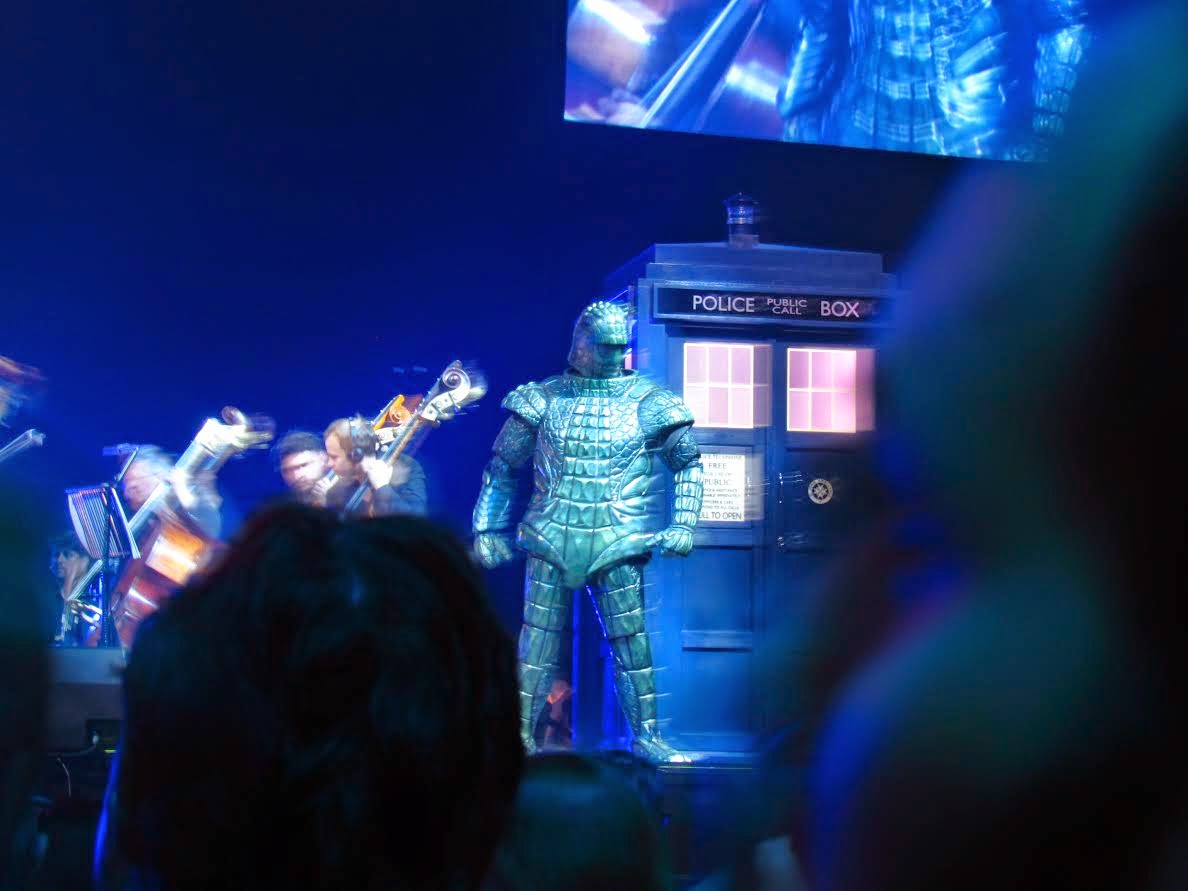
LIVE: Doctor Who Symphonic Spectacular


Review and Photos by Tom Newsom

The official concert based on one of the UK’s biggest TV shows has finally come to, er, the UK. After a couple of tours of Australasia, it’s now moved further afield - starting in London and then travelling to Cardiff, Birmingham, Leeds, Newcastle and Glasgow, cleverly timed for the May Bank Holiday and half term. And it’s a sell-out hit.

I was lucky enough to attend the show at Wembley on Sunday the 24th - which of course was packed with people. I’d watched the various proms from the past ten years before on the telly, but this was my first time hearing an orchestra play them live - in this case, the same BBC National Orchestra and Chorus of Wales that they use on the show (‘the house band’ as host Peter Davison calls them).

Did it go down a storm? Of course it did. A live playing gives the music so much extra energy and emotion, even in a massive arena. And I realised just how much emotion was contained in the music all over again: once it’s stripped from the words if not the visuals, the themes of the episodes and characters are majestic. It’s almost like seeing what’s in the writers’ heads before act structures and appreciation indexes, that raw Doctor Who feeling in all of us.

The set-list seemed very well chosen and skewed quite heavily towards the newest series - performed in these shows for the first time live, and released on CD a week earlier. I hadn’t heard the CD before the show, which meant that I was listening to a lot of the music for the first time away from the episodes. But what a series to go out on - lots of visual episodes, and music from nearly all of them were played. Plus this is the first concert since Peter Capaldi joined - and incredibly, he happened to be in the audience, watching himself and listening to the orchestra play his theme!

When you compare the new music to some of the older, more simpler themes (although the set-list doesn’t stretch back too many years), it’s like Murray Gold is writing the music now with this big, BIG broad sound in mind from the start. Because it’s the big orchestral numbers that are the stars here, especially the opening, which immediately gets the pulse racing.

If anything, it’s designed to be fun - lively talk between the pieces from the excellent host, nothing in the show that’s especially off-putting for children or first-timers (although monsters like the Foretold walking around can give you a fright!), and a whole lot of variety encapsulating light and dark, older and newer, traditional and a bit funky. And there’s slightly smaller but no less powerful pieces like those sung by soloist Elin Manahan Thomas. (Who knew that Missy’s theme had such beautiful words?)

And because of all this, it means it feels like it’s over far, far too quickly!

The Symphonic Spectacular, then, is aptly named. If you’re visiting in future, expect a big, incredible hit of Doctor Who music that will make you feel like a child again. It’s a pretty awesome event.


27 February 2015

TV: Cucumber/Banana/Tofu vi


reviews by Tom Newsom (Twitter | Flickr | Blog)

I watched this a couple of hours ago, and I’m still shaken by it. It’s a beautiful episode, hardly a tough watch in that regard, but god, it stays with you.

Look, just watch it. If you haven’t already - you don’t even need to see the rest of the series really, it’s pretty stand-alone. And in the context of the rest of the series, this seems to be the big one. So, give it a watch - you won’t regret it.

I’m going to be very vague, even though I don’t need to be. Because the set-up before the opening titles lets us in on its secret just enough to set the tone of what’s to come: poignant, tense, often quite dangerous, true.

I’m amazed that this episode was conceived alongside the others. The bouncy comedy that made up some of the previous episodes was written with this in mind, it was acted and shot and edited too. Though of course, this still has the same bounce. The humour becomes black humour, thanks to that dangerous mood lingering over it all.

God. Leaving aside the perfect, inventive acting (Cyril Nri in particular) and everything else, this is the sort of episode that is defined by its writing. If somebody only recounted the plot, it would miss every point there is (and probably turn some of it into issues that aren’t there). This is impeccably handled. What sets it above is the investment we’ve had in the last five weeks (not knowing a thing - consciously!), plus the investment put in to this episode when recalling somebody’s life history in fifty minutes. And then, dramatic scenes, layers and layers of it. And an ending that will shake you and make you cry.

This is a must-see. And afterwards, read this incredible online interview with Russell T Davies.


This week’s Banana is cannily placed, offering a breezy antidote to what’s just happened on the other channel, but with a darker side that fits with the parent show. The link this week appears more tenuous - I don’t think these characters are even in it, at least not this week - but the theme of sudden death comes up over and over.

Because the main character here has anxiety and OCD (at least, that was my interpretation). After six episodes I’m realising that this is, happily, a character based show rather than relying on plot. Last week’s was blissful even when nothing particularly was happening - this episode feels the same. What’s more it’s striving to put people centre stage that don’t normally get focussed on, like most ‘teen’ dramas really.

Amy (played and written by rapidly rising star Charlie Covell) has a date with Kay (a policewoman with few lines but big impact), but is trying to get over her own problems first. It’s quirky rather than mawkish, cute rather than sexy, and the final scene is absolutely lovely.


Tofu luckily doesn’t fit with the theme here. Although there’s some talk of the episode of Cucumber above - you’d be hard pressed to escape it.

This is the episode that felt more like a behind-the-scenes (mostly cast interviews and a lot of clips of the other two series, admittedly well chosen). Which is fine, but this one goes for the widespread general question of: ‘what’s it like filming sex scenes?’. As well as watching and writing - hey, it’s Russell, hooray!

There’s also clips and discussion of Queer as Folk - not massively, but tying all the series together.


many thanks to
Tom Newsom (Twitter | Flickr | Blog)