Showing posts with label Peter Capaldi. Show all posts

28 January 2016

Kroagnon Awards 2016: Day Four - Doctor Who


Welcome to the Kroagnon Awards 2016! All this week, we're announcing all our favourite things of 2015, ranging from the broad to the niche. As well as being voted on by editors Dave, Matt and Tom, several categories have been decided by you, our readers, and industry experts.


The third episode of 2015's Doctor Who series was our favourite. Under the Lake was written by Toby Whithouse, directed by Daniel O'Hara and saw the Doctor and Clara arrive in a base haunted by ghosts at the bottom of a lake. This was a perfect synergy of the talents of contributors in front and behind the camera, creating an atmospheric and involving tale. Next on our list was Heaven Sent. Read our review of Under the Lake here.


It's hard to believe 2015 was only Peter Capaldi's second year leading the series, such is the assured professionalism he brings to the role. This last year saw his Doctor mellow from the more antisocial incarnation of 2014 to a much more amiable figure. It's without a second thought that he is named our Best Actor of 2015, and we hope he remains in the role for many years yet.


Starring in Toby Whithouse's Under the Lake and Before the Flood, Sophie Stone's portrayal of Cass was extraordinary. Even leaving aside the fact that this was (somehow) the first time a deaf actor had played a deaf character in Doctor Who, Stone's performance was memorable and engaging and as such, Cass emerged as one of the most popular guest characters of 2015. 


Doctor Who in 2015 brought with it a host of exciting new and familiar villains but our favourite was the head of the Zygon revolution, Bonnie, as featured in The Zygon Invasion and The Zygon Inversion. Jenna Coleman gave a markedly different performance to her usual portrayal of Clara, showing the range of her abilities, getting to be much colder and steely than normal. It was an extremely strong performance that just managed to edge out Julian Bleach's return as Davros at the top of the season.


Toby Whithouse has been a regular contributor to Doctor Who in the Steven Moffat era, having written his first episode for the 2006 series. His two 2015 episodes - Under the Lake and Before the Flood - were another show of his innovative and exciting writing style, and it's for this two-parter that he is named our Best Writer of last year. We hope Whithouse continues to contribute to the series as he is one of its most reliably entertaining writers.


As in 2014, Rachel Talalay helmed the two closing episodes of Doctor Who's main run last year. Once again she did so in great style, bringing us the series' first single-hander and the return of Gallifrey in two feature-length episodes - Heaven Sent and Hell Bent. These were among the most cinematically-staged stories of 2015, and were even more popular than her début. Also nominated in this category was Hettie Macdonald, director of The Magician's Apprentice and The Witch's Familiar. 


As well as being a highly accomplished camera operator (including on productions such as Peter Harness' Jonathan Strange and Mr Norrell) Richard Stoddard is a rising star in the world of cinematography. This year he served as Director of Photography on four episodes of Doctor Who - Under the Lake, Before the Flood, The Girl Who Died and The Woman Who Lived. His work here speaks for itself and it's a credit to Stoddard that he win this award against the stiff competition of Suzie Lavelle and Mark Waters. More please.


Serving as Executive Producer on the 2015 episodes of Doctor Who, Brian Minchin is perhaps the least celebrated of the core production team, but deserves equal credit for what many are calling the best era the programme has ever enjoyed. It's certainly true that the series would be poorer without his influence and one of the most interesting things that hasn't been discussed in the wake of Chris Chibnall's appointment as Doctor Who's showrunner from 2018 is whether Minchin will be there alongside him. We can but hope.


You probably don't know Will Oswald's name but he has edited more episodes of Doctor Who since 2005 than anyone else. In fact, his closest rival, Mike Jones, has under half the number of episodes to his name that Oswald does. It's thanks to him that episodes such as last year's Under the Lake, Before the Flood, Zygon story and two-part series finale emerge so polished, exciting and professional. Being an editor is a thankless task to the wider viewing public, so we felt it only right that the accolade for Unsung Hero this year went to Will Oswald.


2015 was not short of Doctor Who merchandise, but our favourite was The Scientific Secrets of Doctor Who, written by Dr Marek Kukula and Simon Guerrier. This blended fact and fiction to create an interesting look at how the science of Doctor Who compares to what we know as fact. There's a few highly entertaining short stories in here from respected authors such as Una McCormack, David Llewellyn and Jonathan Morris. Read our original review here.


Our final category for today is the one you voted on. Heaven Sent was an instant hit with viewers, and so it's no surprise to reveal that you voted it your favourite episode of 2015. It was a tour de force for Peter Capaldi, who spend most of this dramatic hour alone, and showcased what the current production team is capable of.

Join us tomorrow for our final round of awards, this time focusing on
the productions of audio company Big Finish!

06 December 2015

Doctor Who: Hell Bent


Review by Matt Michael

Has there been a truly successful series finale in the last five years? After the brilliantly twisty Dark Water, Death in Heaven paid respect to the late Nicholas Courtney by turning the Brigadier’s corpse into a Cyberman. The Name of the Doctor was fun, but felt like an extended prologue to the fiftieth anniversary special. Though it’s aged rather well, The Wedding of River Song was profoundly underwhelming at the time, largely because the Doctor’s absolutely-going-to-happen death turned out to be a whopping great lie.

Hell Bent also reminds us that ‘the Doctor lies’. All those dark hints about the Hybrid were a ruse to get access to the awesome technology of the Time Lords to rescue Clara from a fate – well, from a fate precisely the same as death, actually.

I struggled to engage with the first 20 minutes or so of the episode – the scenes where Rassilon and the High Council went traipsing out to the War Doctor’s barn went on forever with no obvious relevance to the story. Donald Sumpter was wasted, as was Clare Higgins. Whole scenes seemed to unfold just because: the General regenerated into a woman to make the point (as if Missy hadn’t already done so) that Time Lords can change sex - just so long as they aren’t the show’s lead. The Daleks, Cybermen and Weeping Angels were in the Matrix crypt because Moffat’s season finales invariably feature them all anyway. Rachel Talalay keeps these scenes moving, but neat direction’s not enough to disguise a script running on the spot. By 8.25pm I was ready to write this off as a let down, and a waste of the Big Return to Gallifrey.

Then, something weird happened, right about the time the Doctor fled the dullest planet in the universe in a stolen TARDIS. Hell Bent switched gears from lackadaisically rehashing clichés to becoming something approaching magnificent. That gloriously retro 1960s control room is just the icing on the cake.

Back in Before the Flood, the Doctor raged at the Fisher King for stealing the deaths of his victims. Of course, this makes the Doctor an enormous hypocrite, and Clara, as she so often has before, calls him out on it. A woman so stubborn she’s willing to die to prove a point to a man who – as we saw in Heaven Sent – is willing to do exactly the same. What happens when an unstoppable force meets an immovable object? Perhaps the last half hour of Hell Bent.

The Doctor and Clara have been dancing round each other for a long time now. But, eyeball-to-eyeball, both of them knew this was their last dance. Seeing the Doctor slowly lose control – and cool – as Clara’s heart resolutely refused to start beating, hearing them have the same conversation they’ve always had with the urgent edge that comes from the knowledge that they’ll never get the chance again, I was reminded of Moffat’s greatest work: Press Gang. This was Lynda Day having it out with Spike. With Capaldi and Coleman at their peak, it was electric.

Reintroducing Me allows Moffat do pull off the necessary exposition without having to resort to a tedious montage. More, it made explicit a point of view that’s been obvious in Moffat’s work for some time: the answers are never as interesting as the question. Does it matter whether the Hybrid is Ashildr, or the half-human Doctor (yes he is, get over it), or the Doctor’s partnership with Clara? Does it matter what’s inside Amy’s crack, or what the deal is with the Fall of the Eleventh? For many of us, yes. But I think the dialogue between Me and the Doctor sets forth the opposite view cogently.

The scene’s also impressive because Maisie Williams, who up until now hasn’t entirely convinced me, was completely compelling, as if she’s finally relaxed into the part. Ask me before today and I would have quite happily waved goodbye to Me with Face the Raven. Now – not so sure.

So much of Moffat’s era seems to be a response to Russell T Davies’ Doctor Who: not surprising, since the show’s mythology was comprehensively reimagined by Davies in a way that genuinely captured the imagination of the audience. Clara’s final end is clearly influenced by Catherine Tate’s departure, and manages to better it because while Donna’s end was tragic and dark, Clara’s manages to be tragic and light. She’s left with her memories of all those amazing adventures, changed by her experiences, and with access to a working TARDIS and the whole of time and space. Since she’s been becoming more and more like the Doctor, this felt like the proper end.

The Doctor, meanwhile, has a Clara-shaped hole in his mind, but remains fundamentally the Doctor in a way that Donna, stripped of her expanded awareness, was not. I’d say this was the best companion departure since Rose’s; certainly stronger than the Eleventh Doctor’s baffling decision to abandon Amy and Rory in the past. Crucially, Clara is not robbed of her death. It’s still waiting for her, but, as in Face the Raven, she will face it on her own terms. For me, this closed down any suspicion that this was another consequence-free resurrection.

As the conclusion to Series Nine, Hell Bent works well at wrapping up the themes of taking responsibility for your decisions, and living (or dying) with the consequences. The repeated emphasis on these ideas; Ashildr’s regular reappearances, and the number of two part stories have helped to give it a distinctive shape and consistency that’s the hallmark of most of Doctor Who’s best seasons. Like the mystery of Clara’s shop lady, it also leaves a couple of plot points open (have we really heard the last of the Hybrid? Who is the Minister of War? Where’s Rassilon going?). I’m betting Moffat will come back to them in the future – whenever that might be.

I’m of the view this is the best series since 2010, and certainly an improvement over Capaldi’s patchy first year. In a way, this episode mirrors this season: a disastrous beginning that settles down into something richer and more thoughtful than expected.

29 November 2015

Doctor Who: Heaven Sent


There was a moment about halfway through Heaven Sent, when the Doctor is digging out the grave in the cloisters, when I turned to my partner and explained how I thought the story was going to play out. It turned out I was half right (at that stage, we didn’t know about the diamond wall). But this, I think, is a good thing. Moffat plays scrupulously fair with the clues, taking a structure inspired by the recurring nightmare of Dead of Night, and countless horror films since, and combining it with Grimms’ Shepherd Boy. The result, more so than Face the Raven, is Doctor Who’s best example of a dark fairy tale.

Largely because of its empathy with the Doctor’s situation: the fear and grief and anger that drive him, this is easily Moffat’s best script since the fiftieth anniversary; perhaps even since 2010. And this is despite it including yet more hit-and-run assaults on continuity. This time, the target is the truth behind the Doctor absconding from Gallifrey – surely the most over-exposed “mystery” in the series’ history. Malcolm Hulke and Terrance Dicks, Eric Saward, Andrew Cartmel, Ben Aaronovitch, Marc Platt and Russell T Davies have all pecked away at that particular diamond mountain in the last 46 years.

The cliffhanger in particular is a masterpiece of Moffat’s simultaneous fan-baiting, crowd-playing instincts, certain to have some people up in arms and muttering darkly about the 1996 movie, and others excitedly chattering about what it all means. Similarly, bringing back Gallifrey will worry some fans who suspect that if it returns the whole Horde of Travesties will come through as well: the Habitat soft furnishings; the weary Planet Zog politics; Colin Baker in a ridiculous hat. I take hope from the fact that Gallifrey returning does not, at least going by the Next Time trailer, look like a Good Thing, and because Moffat, though willing to play with continuity, has never wrecked it.

In fact, in a curious way, the climax of Heaven Sent reminded me of The War Games: both of them see the Doctor peeling back layers of misdirection to reveal the Time Lords, and the answer to the great mystery, at the heart. In The War Games, Gallifrey is the one place the Doctor’s been running from all his life. Since The Day of the Doctor, it’s been the place he’s heading towards. Both times, it’s positioned as a kind of final destination of his travels, the moment when the series can reach a natural end point. The death of Doctor Who, if you like.

How entirely appropriate for an episode, and a season, that’s steeped in death. It began with Missy brandishing the Doctor’s last will and testament, continued through episodes that have explored mortality and the consequences of immortality; infected all of its viewers with a dusty death, and forced Clara to face the raven. As a literal manifestation of the ‘second shadow’ that haunts everyone from the moment they are born, the Veil is a supremely effective image. It takes the tired old convention joke about trying to make running through corridors away from a shuffling monster look dramatic, and turns it into something truly nightmarish.

What really sells the monster, as it always has, is the Doctor’s reaction to it. Capaldi has already been universally praised for his blistering performance in the otherwise fatuous climax of The Zygon Inversion. I think he betters it in Heaven Sent, and while he’s not uniquely capable of carrying an episode pretty much single handedly (how many classic Doctors had to do that regularly, in one take?), he is absolutely compelling. In years to come, this will be rightly held up as one of the all-time great Doctor Who performances.

Whether Heaven Sent is held up as one of the all-time greats remains to be seen. Since The Sensorites, posterity, and fandom, hasn’t always been kind to outstanding first episodes with lesser second parts, and a huge amount rides on Hell Bent. But right at this moment, I’m willing to bet this season is going to go up and up in people’s estimation.

15 November 2015

Doctor Who: Sleep No More


Sleep No More isn't trying to say or do anything in particular, it's just an experiment into uncharted territory for Doctor Who - but it doesn't work, writes Tom Newsom.

I’m sure some people must love it, but I never hear anyone admit that in public. The ‘found footage’ genre, normally for low-budget horror, has been ubiquitous in the last five (ten? fifteen?) years. I’m not an expert in it by any means, but it offers a very different form of drama to the one we’re used to in Doctor Who - something more distant. However given its widespread use, doesn’t it feel like a great fit for a scary episode? In theory, perhaps - but here it just left me cold.

You can’t call this episode conventional, in any sense. But I’ve surprised myself, thinking back, how many things it gets spot on: the monsters especially. Sleep, the sandman, it’s an irresistible connection, played to its full here. But the camera moving means that we barely glimpse them at first - a plus for anything trying to scare us. And then when we see more, it’s just a deformed blob with legs and a gaping mouth - eurgh. They’ve got one of the sketchiest backstories and behaviour - “sleep dust” is all there is to them - but they don’t half scare.

It’s a great production, especially when you consider it was filmed with the normal HD cameras, as opposed to smaller models attached to the actors. The camerawork can really make you feel the action even when people are standing still, and the editing is faster. Parts of this episode are INTENSE, the scary parts, which you don’t normally get with Doctor Who.

It’s definitely an episode that will be rated a ‘12’, in a series that’s had at least four of them so far - so god knows what young children thought of it. I remember being scared watching Jeopardy, a CBBC Blair Witch Project-style series, when I was younger - and that was just kids in a field with cameras, rather than full-blown Aliens.

But there’s only that intensity to parts of it. For the rest of it, normally the talky scenes such as at the start or with the supporting characters, it starts to grate. Yes, really - Doctor Who is a programme that actively tries to not be boring, always. But when it’s a group of guest characters who you barely even recognise (let alone care for), who are muttering in wide-shots with shaking cameras - well, you pray for a good closeup. Thankfully we get a few, of the Doctor especially (him and Clara are a welcome presence this week), because otherwise you’d struggle to feel a part of the action, even with the point-of-view business. At some moments it didn’t feel like television to me at all, more like a first-person shooter - really, for Doctor Who?

The helmet cameras, or lack of, was a good twist though, in an episode that had more standout moments than it deserved. The plot is involved just enough, building up and teasing out a few mysteries. Okay, I felt good about wondering to myself why we were seeing things from Clara’s point of view (or whether there was another soldier character I’d missed). The story about the Morpheus process was well told too, with its slightly creepy set-up involving “that song”. Less so about the hunt for the villain behind the piece - by then I was confused what the overall monster plan was, though so was the Doctor.

It would be cruel to sign off a review with the Doctor’s closing comment - “none of this makes any sense!” - so I won’t. Instead, I’ll highlight the cool and utterly terrifying closing shot of Reece Shearsmith. Good to have him in Doctor Who, and a perfect fit for this particular part. This episode feels like an Inside No 9 on BBC Two, if its budget was tripled overnight.

Really though, this is Doctor Who (and writer/horror fan Mark Gatiss) having fun with a particular genre. You can tell that through the ways they’ve tied it into the story - the ‘found footage’ of the “cameras”, and the message that frames the story. It’s not like a film, in that the director is using it to make a statement or a higher art-form. This is purely them trying new things, an experiment of an episode for this week’s audience.

I’m just not quite sure it works.

25 October 2015

Doctor Who: The Woman Who Lived


Review by Tom Newsom

The second in a two-part story - or is it? Regardless, it’s one of those uncommon episodes of the show - one where characters and themes and messages take over an otherwise standard plot, this time with magical results.

At first you might think you’d skipped an episode, what with the sudden change in setting. But this one complements last week’s “opening” part to the story rather more closely than you’d expect. The action-adventure strand in both is slight, but there are big discussions on life and death. Bravely, this episode is for the first half a lengthy two hander (no Clara!), before the action widens out. It’s great to have a smaller episode that still manages to be very compelling - I was captivated.

Much of it’s down to Maisie Williams’s character - what a part! The range is extraordinary - going from Viking girl last week to seventeenth century woman... probably because it’s basically two separate characters. It’s an inherent weakness that this episode doesn’t naturally follow on, and that’s the point. The character of Ashildr has grown up, hundreds of years older, and can’t even remember when she was born. Her morals have changed beyond recognition - as has her style! - and she’s become an interesting, headstrong figure who has run away from her past.

Oh, but it’s here where the best, deepest part of the episode is. Ashildr’s assumption that the Doctor has come back especially is undercut by the alien artefact plot; she’s just a coincidence, and plenty of adventures have happened since. But the Doctor’s well-meaning gift of an second “immortality charge” incase she meets someone she likes is undercut by the reality- she’s immortal, she doesn’t get close to anyone and she’s only got one patch; as she says, simply, “nobody’s good enough”. There’s plenty of touches here, quickly told to us - her mastering every skill through being alive longer; her disregard for her own species coinciding with becoming a highwayman; seeing her life through history culminating in tragic loss.

And then there are the parallels between her and the Doctor - it’s not particularly subtle by the end of the episode, but it makes the whole thing sing. The Doctor is advising Ashildr to notice the little people, the “mayflies”, an about turn perhaps from last year into the Doctor we know and love. He admits, though, he hasn’t made Clara immortal in the same way, even though he’s said he won’t bear to lose her. It all adds to the foreboding mood this series.

It’s a very handsome Doctor Who episode, thanks to some great imagery from the script (picking a very fancy period of history, and adding in a big kingly lion too). It looks stylish, with the night-time scenes lit blue with orange candles reminding me of Poldark’s house style, by the same director. But it’s not just the look - combined with the previous episode, Ed Bazalgette has managed to produce the ultimate Who calling card, with two perfectly paced adventures (in my opinion), telling a story on a grand scale.

The plots in both this and last week’s were admittedly slight - or simply a foreground to a wider canvas of the immortal, eponymous Ashildr. Leandro the Lion is both a cool monster and a fearsome foe, though his purpose sticks out more obvious than most this week - to provide a test of Ashildr’s character, as well as the obligatory monster of the week. He keeps to the shadows (unfortunately -the make-up is nice), and gets about as much screen-time in the end as the controversial Sam Swift the highwayman. I like Rufus Hound, and I like a rude joke as much as the next man - but I expect the “gallows humour” scenes will get some stick, in an otherwise grown-up episode. Personally I found it the best kind of silly jokes, even if it all goes on a bit too long, necessary to lighten the mood, with a performance containing all that sadness behind the humour.

If it invites comparison to Doctor Who of old - not that every episode does - then Enlightenment jumped out at me, and not just because it’s one of the increasingly rare examples of a TV episode written by a woman. Both are different from the normal stories the show tells, and curiously they both end up mixing poetic, immortal characters with history and aliens. Not that poetry and big ideas is limited to those two - look at Warriors’ Gate, Kinda, or Survival, or Vincent and the Doctor, Kill the Moon or In the Forest of the Night. The Woman Who Lived is one of those rarefied, unusual slices of Doctor Who that works on both levels - as a family adventure and a sweeping, engaging drama.

At the end, we have Maisie Williams - a very successful, commanding performance, even when it’s hyped beforehand - joining the pantheon of potentially recurring Doctor Who characters, and an immortal one at that. The sorts of people he considers to be his friends, who can pop up whenever and wherever the writer wants - Moffat’s a fan, of course. I didn’t quite buy the rather Torchwood-esque group Ashildr was going to set up, nor do I think it will be returned to any time soon. Because one of the clever things about the show, is that in following episodes, if a writer wants to feature her again, they don’t have to stick to the established events at all. Like the Doctor, the show can write its own history as it goes. Whether this episode sinks or swims in that history remains to be seen.

18 October 2015

Doctor Who: The Girl Who Died


In terms of eye-catching imagery, this one grabs your attention. “Doctor Who meets Game of Thrones!” says the Radio Times (slightly superficially, given the actual episode). “Vikings Vs Aliens!” cries another. And if you’re thinking that it sounds fairly typical for the series, this story takes a simpler plot, tells it well, and makes good use of the extra room for smaller, snappier scenes. After the spooky but rather scientific investigations of Under the Lake, I liked this one even more. It’s my kind of Doctor Who.

It’s also yet another take on an established genre. No, not Vikings, but the classic, Western movie trope of a village being under siege and having to train up the villagers to beat the invaders. Not that it’s the first time it’s been used in Doctor Who. Having the Doctor gatecrash another type of story is one of the show’s staples, as it allows everyone to have some fun, and it’s the only type of show that can get away with it so often. This episode has some fun with it, with the Doctor training up the villagers and doing his best army general impression. But mostly, it’s played for real. He knows full well that the villagers are going to die (he argues they have to die, using his logic, because otherwise it will cause too many ‘ripples’ in time). The odds are against him more than ever in this impossible situation.

If that sounds less action packed than most stories, you’d be right. The story breezes along rather nicely, with some steady direction. After a fast paced introduction where we’re (very) speedily thrown into the situation this week, the story settles down into... introspection. The Doctor isn’t a fighter - actually, there’s very little fighting in this story at all! - he’s a thinker. And when the enjoyable and especially funny quips die down, there’s a rare chance for the show to delve a bit deeper into the characters than they usually do in recent years. Or have the Doctor and Clara talk about weightier issues.

The standout emotional scene in the middle of the story is the Doctor ‘talking’ baby. It’s taking what was presented as a joke from previous episodes, and perhaps being inspired by Peter Capaldi translating the dinosaur in Deep Breath too. The sound of a baby crying alone didn’t work in sparking the village into action, so the Doctor translates it into language and it becomes sweet and sad and a glimpse into an unknown world. All of this in a few spoken lines - and it’s enough of a moment to hang the rest of the story onto it.

I feel sorry for the new aliens, though. The Mire look and sound pretty cool, and the design does a lot of the work for them. But they don’t get much of an outing in this episode, when most of it is devoted to the Doctor and Clara. Pitching them as Viking-like in morality makes them stand out from the rest of the show’s pantheon straight away, even though we know very little about them otherwise.

The episode strives to be entertaining, with the Doctor on fine form. This week Peter Capaldi is cast as a mad god and a rational thinker rolled into one, and a goofier side to some of his humour. As ever, he feels unpredictable - hell, this Doctor feels like Tom Baker, having that alien aloofness of not caring for human matters, masking the love of the trivial, and deep friendship with his companion. Clara, you could say, occupies some of the more traditional role as she’s becoming more like him - she can stand up to the aliens too. But also she’s definitely got that shared bond with the Doctor as they understand each other much better. (All the more important to keep those talky scenes rather than reduce it all to shorthand)

It’s Doctor Who on strong form - reminiscent in broad terms of last year’s Robot of Sherwood (down to some of the expansive sets and the sunny look), but even more successful, if a more sketchier drawn setting. The Viking setting is a catchy look, but populated with everyday characters, with more detail being sketched in with new girl Ashildr. She’s cleverly played as just a normal, quiet young girl, but cleverly written to make her more Viking and less modern and immediately likeable. Her strengths are slowly revealed, and they are in her character rather than in her funny quips: her heart, her storytelling, her innocence. It’s a good role to build a story around.

For all the build-up to this particular episode, overthinking fans might feel a bit underwhelmed by the result. Sure, Maisie Williams’s casting is exciting, even when you discount the theories as to her character - cue the inevitable list of old friends and foes. But the episode itself (titled The Girl Who Died!) acknowledges that her character will be important right from the start, even if it cheekily puts the Doctor’s interest in her down to a premonition - “remembering in the wrong order”. Looking back, it’s pure mystical foreshadowing, but at least we can be comforted in the knowledge of another 45 minutes continuing the story next week.

11 October 2015

Doctor Who: Before the Flood


There’s an argument – probably raging, as we speak, on one of the forums – that time travel has become an over-used plot device in modern Doctor Who. Outraged fans will point to the fact that the TARDIS was barely used as anything but a means of transport in the classic series, whereas nowadays it’s all too often the means to solve the plot.

Up front, I have some sympathy with the argument: if the Doctor can just go back and rewrite history, or worse still, rewrite people to make them his puppets, the show instantly loses a big chunk of drama and instead becomes an exercise in joining the dots. Hence my reservations about ‘going back’ at the end of Under the Lake.

What I wasn’t prepared for was the way Before the Flood directly addresses those reservations – and the audience. Starting off with a brief, Listen-style lesson on the bootstrap paradox (with a grin-inducingly audacious guitar riff into the opening titles), this episode becomes less about how the Doctor saves the survivors of the underwater base, and more about the morality of tinkering with time.

It threatens to be at its least effective when it’s confronting the Doctor, yet again, with his inevitable death. Having seen him wriggle out of it at Lake Silencio and again on Trenzalore, my eyes did start to glaze over. But again, Whithouse was ahead of me: it’s merely a prompt for the Doctor to become genuinely outraged at the Fisher King for bending the rules not of time, but of life, and for robbing his victims of their deaths.

Ultimately, the episode resolves into a quietly furious excoriation of going back to ‘cut tragedy off at the root’, because to do so robs life of meaning. In Before the Flood the dead characters stay dead, and this gives the episode its most emotional beat: ‘There is no point wasting time because things happen and then it's too late.’ Sometimes Doctor Who has forgotten this truth, and become glib about death. Before the Flood is a necessary correction.

It’s also an episode that plays resolutely fair with the audience. Aside from highlighting the bootstrap paradox at the start – and holding its hands up to the same at the end, everything else was set up in Under the Lake, from the idea of the TARDIS hologram projection facility, to the Doctor escaping in the suspended animation cabinet, to the missing power cell that blew up the dam. The Doctor doesn’t even need to rewrite time to win, he just needs to convince the monster that he might.

Understandably, given last week’s cliffhanger, this is Capaldi’s episode, and it’s my favourite of his performances to date: that slight awkwardness of movement and around people, and a strange, spiky run that’s as distinctive as Pertwee’s arms-in-tight dash. This regeneration might be a clerical error, but it’s one that’s working in our favour. Against this, the Doctor’s dedication to Clara is again shown to be not entirely healthy, with Bennett calling him out on caring more about her life than O'Donnell’s, and the Doctor admitting that Clara’s name was the prompt for him to act against the Fisher King. What this devotion might mean in the future – like the dark hint about the ‘Minister of War’ – remains an intriguing mystery.

Not so mysterious is the Fisher King itself. It is a charmingly trad Doctor Who monster, by which I mean it’s most effective when glimpsed in the ruins of the Soviet ghost town, or lurking in shadows and close ups than when shuffling, in long shot, across the grass. Also, I guiltily admit to not really noticing the Slipknot ‘roar of the Fisher King’. But since the episode isn’t about the monster, that doesn’t really matter. The really scary thing about those scenes in 1980 is the sense of looming threat, which is doubly reinforced by the dam towering over the village, and the iconography of Cold War Armageddon. Daniel O’Hara’s choice of an icy, washed-out palette is a good one: these scenes are really chilly, and neatly counterpoint the sickly green corpse light of the underwater base.

Together, Under the Lake and Before the Flood comprise my favourite Capaldi story to date. It pulls on some of the style of classic base under siege stories, while drawing on and explicitly critiquing some of the modern show’s clichés. Dramatically satisfying and clever, it’s ideal Doctor Who.

04 October 2015

Doctor Who: Under the Lake


Review by Matt Michael

What a joy, after Series Nine’s opening two-parter, which took almost as long as Eric Saward to get the Doctor to the plot, to see Under the Lake achieve the same outcome within four minutes. Of course, ten times faster doesn’t automatically equal ten times better, but it’s not far off.

This speed is achieved with some neat shortcuts. For example, there’s a clever economy with the characters - Pritchard is the money-grabbing annoyance, O’Donnell is another UNIT fan in the style of Malcolm and Osgood, Bennett is a bit cowardly, and Moran is the dependable base commander. The only surprise there is that the commander gets killed off first, whereas normally they’re the gruff and suspicious one the Doctor gradually wins over. Instead, the Doctor uses the psychic paper to bypass all that routine stuff, and the commander’s role is given over instead to Cass, whose deafness thankfully hasn’t, so far at least, become the solution to the plot in the way Daphne Ashbrook’s character’s disability was in the ‘worthy’ Deep Space Nine episode Melora.

It seems counter-intuitive to be focusing on the speed of Under the Lake when modern base-under-siege stories such as Cold War and The Waters of Mars have managed the whole deal in a single episode. Again, Daniel O’Hara’s direction emphasises the pace even when the characters are confined to a handful of sets. There’s an outrageous amount of running through corridors, particularly during the central ghost-hunting sequence. But even the exposition scenes move with an unusual energy helped by touches such as the Doctor’s visual representation of the Dark-Sword-Forsaken-Temple coordinates, and the ability to bounce the dialogue around lots of characters.

That pace makes two slower scenes stand out, and both of them have a similar point: Clara’s increasing recklessness. Inside the TARDIS (nice touch up, by the way) the Doctor warns her off becoming too much like him. And then later, Bennett contrasts himself with Clara – more of a ’bleeder than a fighter’. Clara, however, has become a danger junkie, desperate for ‘monsters and blowing things up’ and always wanting to go ‘where the action is’. There’s the implication she’s running from a life without Danny. I’d be surprised if this theme wasn’t leading, in some way, to her departure later in the year

For the time being, though, she’s well paired with Capaldi, whose performance has lightened. Given he’s the oldest of the modern era Doctors, he plays it like he’s the youngest, rushing about like an excited teenager, constantly thrilled by the latest new thing. Watching the two of them, I was reminded of the irrepressible energy of the first Doctor and Vicki in The Romans, which can only be a good thing.

It’s this energy that saves Under the Lake from becoming too dark. Whithouse is an effective horror writer – Being Human, The Vampires of Venice and The God Complex and the traumatising pre-credits sequence of School Reunion are obviously testaments to that. Here we’ve got legitimately creepy ghosts who play on the old myth that the eye retains the last image it saw after death. We’ve also got a fairly graphic drowning and a man being burned alive. Then there’s that cliffhanger, with the Doctor’s spectre, made up to look like Peter Cushing in Tales from the Crypt, floating through the lake.

It’s a good place to end the episode, although five years of timey wimey have conditioned me to expect the very much alive Doctor to turn up inside that deadlocked suspended animation chamber next week. My one big reservation about the story so far (the little reservation: how did the sonic specs transmit from inside the sealed Faraday Cage?) is the time travel at the end. A change of scene for the second episode is probably necessary in the modern two-parter, but I always look askew at using the TARDIS to solve the plot – if he does it this time, why not every time?

That said, Under the Lake definitely whet my appetite for Before the Flood. After the opening diptych felt like a good two-hander for the Doctor and Davros with a lot of flabby padding around it, Whithouse has raised the game with a much more compelling piece of work. All that water, and not a damp squib in sight.

27 September 2015

Doctor Who: The Witch's Familiar


Review by Tom Newsom

Doctor Who has legendary stories, those images and scenes that have lasted long in the memory. The sort of thing that’s talked about in the playground, or reiterated in fan publications (icon or not): Daleks invading London, Cybermen out of their tombs, Sea Devils rising out of the sea, Davros. Hopefully Series 8 and 9 have provided a few more. And the show thrives on these - the fans picked up on them over the years, then created their own stories and retold the mythology when they then took over the show.

Some of these have been revisited - followed up as a sequel, or lovingly ripped off as a remake, depending on your point of view - but curiously for the TV series itself, not the earliest of imagery. Now, and only now, we’re taken back to the metal cities of 1963. Perhaps it’s because the technology has finally caught up, as I doubt Skaro would look as impressive as in people’s memories if it wasn’t in HD and fine lighting. This story harks back in every way - old Daleks, and the plot points from the first Dalek story like the trip to the city and the companion getting inside one. Davros and his speech from Genesis of the Daleks and Tom Baker with the wires. Whether or not it adds something new might depend on your point of view.

Except it’s much more than old scenes playing out with a nod and a wink. The show is doing that great, marvellous thing of going beyond the imagery and telling us something new about the Daleks and how they think. And it’s marvellous that in every story they come back in, we always find out something new - and it always feels like a big secret! It’s not just them, either. Taken all the way to Skaro, in the heart of the city of the Daleks, and it feels like a character piece. The Doctor and Davros, Missy and Clara - we find out more about all of them.

The Doctor's morality doesn’t seem to be questioned, not like we saw last year. He knows he’s a good man, and a bad man, and an idiot. And not a very good doctor - but a brilliant Doctor. He’s robbed of the best lines in this one, but he’s out of his comfort zone, and we never quite know what he’ll resort to next - even when he’s stealing Davros’s chair! We’re always with him, though - it’s a great performance.

The scenes with Davros and the Doctor are the most important here, and among the most grown-up we’ve seen since, well, last year’s rather grown-up stories. Here are two old men, enemies who pity each other, sensing the long, bitter end. I can’t imagine any other of the Doctors having this talk with Davros, not really, yet here it fits. The episode is happily full of parallels, with Davros’s character compared to the Doctor’s, and Missy being both friend and foe as well. It’s like two retired generals facing each other, as there’s an element - for a while - of differences being put aside. I realised I’d missed the typical gloating, power crazed Davros, so it was nice to see a return to that in some scenes. But it merely rounds off a very nuanced, well written character for this episode - the bit with his eyes, for instance, breaking an unwritten rule for pure emotional effect, forcing us to look at old Davros as we never have done before. Hats off to Julian Bleach; and hats off too for the incredibly detailed make-up on him.

As her double act with Clara showed, Missy’s the Doctor but with different morals. She’s a joy to be with - the sort of Doctor figure we aren’t seeing in the Davros scenes, you could argue - if very fast and occasionally incomprehensible. Having her and Clara together really, really works; it’s the sort of partnership that was all too fleeting with Roger Delgado and his ‘Miss Grant’, dropped since. Much more of this, please.

And Clara. Brought along for a hell of a ride, but knowing how much she means to the Doctor, she’s put through hell with this episode, as the situation gets even more dangerous (and a real Sarah Jane Smith level of companion hell, too). I wonder if the terrific scenario at the end with the Doctor facing her is a sign of things to come...

But really, it's about the Daleks. They have little screen-time, really, but a big presence. After all, the Dalek city is back, the often-extinct race are alive once more. Their personality, not just as an alien race, but as an engineered race who started off as human but, through the choices of a madman, or a frightened child, ended up conquering worlds. And replacing emotional thoughts with firing weapons. It’s all there, literal, in this week’s story. If that’s not an icon properly restored, I don’t know what is. Fantastic.


20 September 2015

Doctor Who: The Magician's Apprentice


It’s exactly the sort of story you’d expect if they ever decided to do a Doctor Who movie, yet it’s being shown at 7:40 on BBC One. The show is back, hitting the ground running. Like the man himself, they’re trying to make a big entrance, cramming it full of everything Doctor Who, new stuff and old. An opener that appears to be aimed at fans - well, fans of Genesis of the Daleks at least!

But first, Michelle Gomez. (“Not dead. Back. Big surprise. Never mind.”) Throughout this, she’s playing to the gallery - literally, in the scenes set in medieval Essex. But it’s the quieter scenes earlier with Clara that really grabbed me. It’s a rare moment of calm and it re-establishes her as a friend, as well as an enemy. Funny how they never say the words ‘The Master’, relying on everybody knowing the character from last series - because what an impression she made last series. Even though the power dynamic has changed since Death in Heaven, she’s still incredibly watchable, still 90% perfect and trying something new all the time. Nice direction in this episode, by the way, though I’m not sure how easy it is to direct Michelle Gomez!

On the one hand, then, it’s throwing in history and more fan references than ever - Missy, Skaro, Daleks, UNIT, Karn, the Shadow Proclamation, everything in the Doctor Who encyclopaedia. But most of the obscure appearances are glib, most of the back-stories are snappily reiterated. Casual viewers might be running to keep up with the madness of it, but they won’t be completely lost. And even they might appreciate quite how big the events are in this story - it feels like new (and old) territory, going into places that we were never able to go before. Exciting, and this is the opener.

Keeping the Doctor from the action is a risky move - making his absence part of the plot is also risky when there isn’t a lot else keeping the action going. This episode manages to sustain it, just.  Peter Capaldi, and later the Daleks, has a big impact when he finally appears. In this way, it’s as unusual a set-up to an episode as last year’s opener, Deep Breath, but the two couldn’t be more different in terms of style and scale. It’s quite an achievement that this episode was kept intimate - three main characters, forced together by events - as well as being pure spectacle, having a few masterstrokes up its sleeve that add to the mystery.

The heart of which seems to be the Doctor himself - this time he seems to think he’s going to die (must be a Tuesday). We’re with Clara, left struggling to catch up. A decent explanation can be found in the fairly substantial mini-episode ‘The Doctor’s Meditation’ - if you were able to work out its complicated ‘online exclusive’, region locked distribution before the series started. That’s a shame, as it’s the answers that were glossed over in the episode itself.

Sending the Doctor on his own quest between episodes is a trick that’s been done before in some of Steven Moffat’s bigger stories (The Snowmen, A Good Man Goes to War, etc), and I’m never totally comfortable with it - which might be the point. It’s a long way from when we last saw him, nine months ago, as if the show always has to keep evolving, that we should never tune in and think we know the Doctor. The show should be surprising us, constantly, always changing.

More things signify it’s a Steven Moffat episode - reviews should come with a checklist of praise, now, to save time - as every scene has a cool idea, and tons of surprises, even if we’re not entirely sure what they all mean. There’s plenty to marvel at: Colony Sarff’s very alien nature being revealed to us gradually; the grabbing hand-mines creating more playground games; the time freezing of the sky as a visual effect; all the mystery involving the hospital and the Daleks coming back. Somehow they all fitted together on screen nicely (again, good direction). But then it’s the start of the series, and this time we’re expecting the big visuals - and how much bigger can you get, with enemies like these? And, as ever, it’s also full of humour - this time, at least half of it as outrageous as the plot.

If I haven’t made it clear already, it’s very very big. But, even though it’s a two-part opener, what’s the story about? It takes us until the final scenes to realise, it’s about the Doctor. It’s about a certain choice he’s had to make, carrying on a theme from last year. The earlier scenes resonate with his difficult choices with Clara (who's very much not in a companion role this episode, and all the better for it), and much earlier in his past with Missy. But these scenes of gathering everyone together doesn’t add anything to the main events on Skaro - full of cool ideas, as the show needs, but we move on quickly onto shinier things. Let’s hope there’s more to it than that.

This episode definitely felt like the first half of a movie, just building and building all the time, so that when we got to the cliffhanger... obviously it’s left me keen to see the rest, with no clue of what the rest will actually play out like. Of course, Jenna Coleman’s leaving, so she’s obviously gone now - right?

All bets are off...


25 May 2015

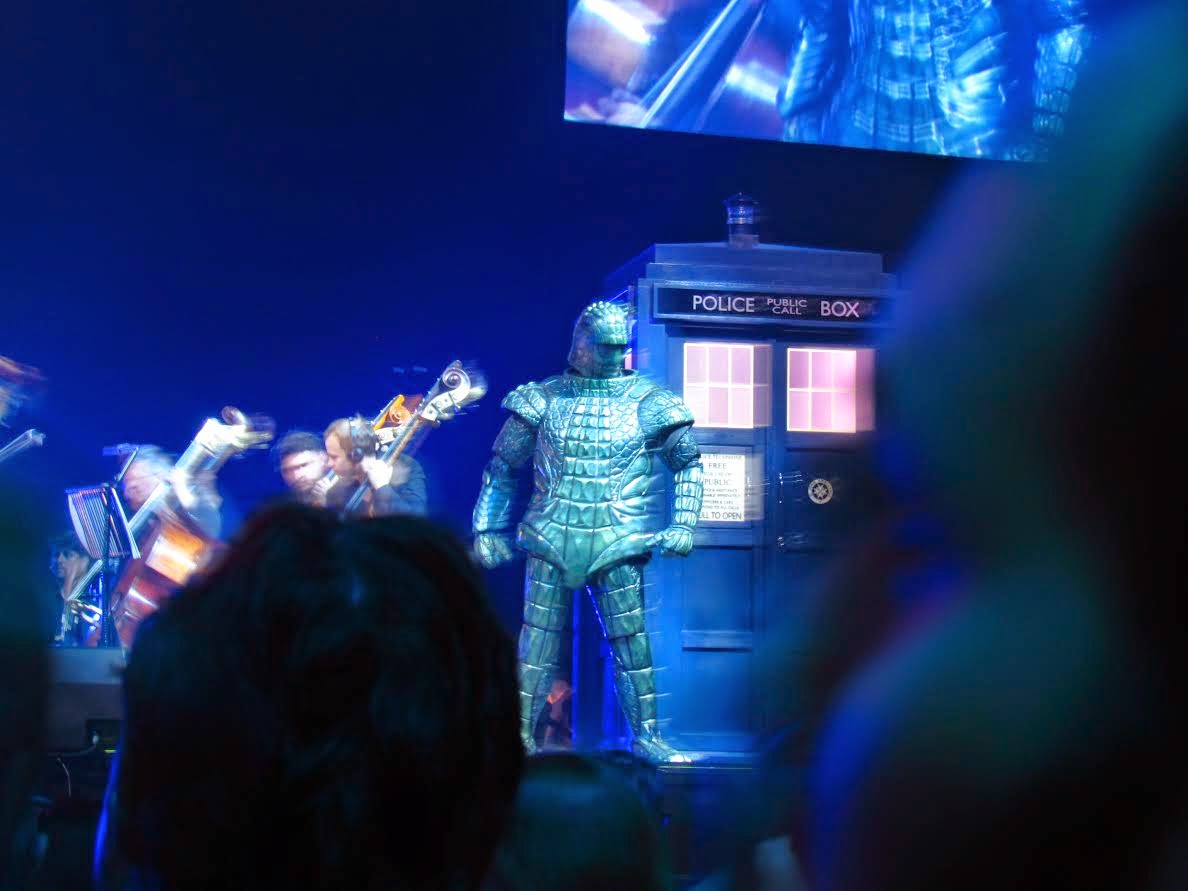
LIVE: Doctor Who Symphonic Spectacular


Review and Photos by Tom Newsom

The official concert based on one of the UK’s biggest TV shows has finally come to, er, the UK. After a couple of tours of Australasia, it’s now moved further afield - starting in London and then travelling to Cardiff, Birmingham, Leeds, Newcastle and Glasgow, cleverly timed for the May Bank Holiday and half term. And it’s a sell-out hit.

I was lucky enough to attend the show at Wembley on Sunday the 24th - which of course was packed with people. I’d watched the various proms from the past ten years before on the telly, but this was my first time hearing an orchestra play them live - in this case, the same BBC National Orchestra and Chorus of Wales that they use on the show (‘the house band’ as host Peter Davison calls them).

Did it go down a storm? Of course it did. A live playing gives the music so much extra energy and emotion, even in a massive arena. And I realised just how much emotion was contained in the music all over again: once it’s stripped from the words if not the visuals, the themes of the episodes and characters are majestic. It’s almost like seeing what’s in the writers’ heads before act structures and appreciation indexes, that raw Doctor Who feeling in all of us.

The set-list seemed very well chosen and skewed quite heavily towards the newest series - performed in these shows for the first time live, and released on CD a week earlier. I hadn’t heard the CD before the show, which meant that I was listening to a lot of the music for the first time away from the episodes. But what a series to go out on - lots of visual episodes, and music from nearly all of them were played. Plus this is the first concert since Peter Capaldi joined - and incredibly, he happened to be in the audience, watching himself and listening to the orchestra play his theme!

When you compare the new music to some of the older, more simpler themes (although the set-list doesn’t stretch back too many years), it’s like Murray Gold is writing the music now with this big, BIG broad sound in mind from the start. Because it’s the big orchestral numbers that are the stars here, especially the opening, which immediately gets the pulse racing.

If anything, it’s designed to be fun - lively talk between the pieces from the excellent host, nothing in the show that’s especially off-putting for children or first-timers (although monsters like the Foretold walking around can give you a fright!), and a whole lot of variety encapsulating light and dark, older and newer, traditional and a bit funky. And there’s slightly smaller but no less powerful pieces like those sung by soloist Elin Manahan Thomas. (Who knew that Missy’s theme had such beautiful words?)

And because of all this, it means it feels like it’s over far, far too quickly!

The Symphonic Spectacular, then, is aptly named. If you’re visiting in future, expect a big, incredible hit of Doctor Who music that will make you feel like a child again. It’s a pretty awesome event.


26 December 2014

TV: Last Christmas (Newsom)


review by Tom Newsom (Twitter | Flickr | Blog)

There’s some smart lines, a nice tune - not all that Christmassy, but a proper catchy sing along classic from Wham. 9/10

Oh wait, this is a Doctor Who blog. But actually, this is pretty Christmassy - though you’d struggle to have Santa and for it to not be. There’s plenty more stuffed in here too, with traditional sci-fi science bases, icky monsters and clever fantasy trickery. Ho ho ho! This isn’t exactly light Christmas fare - the plot is more important than most for these specials - but it’s deceptively complex, a run-around that has its focus on Clara leaving the Doctor more than anything.

Let’s not forget that Santa is the big selling point here - the real Santa! Santa in Doctor Who - it’s genius! Nick Frost fills out the character in every way, breathing life into the traditional image without sending it up, even when wisecracking. He easily stands up to Peter Capaldi, even if it feels like he should be in far more scenes than he is. The other characters fall into the shade but they seem well cast, with Faye Marsay perhaps unexpectingly standing out the most.

In fact, with Santa appearing (real living Santa!) along with all the trimmings, it’s a surprise that the whole thing isn’t sent up. It’s not that preposterous by Doctor Who standards, but it could easily slip. But this is coming from the director of the foreboding and adult Kill the Moon and it’s a Steven Moffat script, and so is full of Moffat tricks. Would any other show on telly at the moment be up to an episode full of dream sequences and televisual quirks with nobody batting an eye? Perhaps Black Mirror or Sherlock do the same sort of thing too, but that’s about it. For Christmas Day viewing they aren’t going soft: this episode throws in everything - some with complete success (Slade beats monsters!) and some that feel slightly too indulgent (Michael Troughton’s cool death feels like merely that).A special mention has to go to the design and the effects too - we’re in proper movie territory here.

If there’s a downside, it’s that it’s not movie length. The sixty minutes flew by, but here more than ever it feels there’s not enough time to take everything in, especially when you’ve got these sorts of big ideas. The lack of exposition at the start - it skips from Clara meeting the Doctor again to investigating the space base very quickly with little to no reason why it’s all happening - is a clever double bluff, especially clever as it’s the sort of frantic opener we’re used to (or that I’m used to not enjoying!). But even if it’s part of the plot, I think the beginning of the episode suffers because of it.

I did want to see more of Santa being Santa, or even more of Clara and the Doctor being themselves rather than being in mortal danger. This episode has it in spades, managing to keep up a strong pace when the plot itself is literally unravelling as we’re told to forget what previously happened. It’s a puzzle box of an episode that works (and only works really) as a one-off special, and the whole thing feels very solid rather than the writer constantly keeping the plates spinning when the dreams start recurring. It helps of course that the core elements are so joyfully mismatched - yes, some of them come very close to ripping things off (it even mentions most of its film influences in the episode itself), but it’s exactly the sort of thing we want to see. And it’s Christmas. So there.

The most recent series isn’t nearly forgotten about (after all, it’s only been a couple of months since it finished). It’s a proper continuation rather than the tradition in recent years of being standalone in style and tone as well as the characters. This dealt with the same relationships that we saw in Death in Heaven, almost trying to top it. I love that they brought Danny back indulgently as a Christmas present, but sort of gave him a proper goodbye without spoiling the previous one. And that ending that kept you guessing? Like in the Wham song, I think we might all need to be given new hearts after this one.


many thanks to
Tom Newsom (Twitter | Flickr | Blog)

09 November 2014

888: Series 8 Round-Up

It wouldn't be the end of a series without an Artron Reviews round-up post. To celebrate the conclusion of Doctor Who Series 8, we've invited some of the best-loved reviewers, writers, artists and all-round good eggs from within the Whoniverse to sum up Peter Capaldi's first twelve episodes in 8 words each. Here's what they came up with.


Lee Binding
(Digital Artist/Graphic Designer | Twitter)
"Alien rediscovers his humanity, friend almost loses hers."


Will Brooks 
(Digital Artist and Reviewer | Twitter, Tumblr)
"Twelve slices of Doctor Who at its best."


Philip Lawrence  
(Writer, Actor, AFT Manager | Twitter, Action Figure Theatre)
"Nice try but Capaldi didn't win me over."


Stuart Manning
(Digital Artist | Twitter, Facebook, Flickr)
"Mad minxy Missy Master's mausoleum much mischief makes."

 
Una McCormack 

(Writer and Creative Writing Lecturer, Anglia Ruskin University | Twitter, Website)
"Thoughtful, consistently good and blessedly story arc lite!"


Matt Michael
(DWM Reviewer, Blue Guard | Twitter, Podcast)
"Moffat's largely successful attempt to confound his critics."


Jonathan Morris
(Writer, Father, Hero | Twitter, Blog)
"Fantastic Doctor/companion/scares, but not for kids?"


Tom Newsom  
(Fan Writer, Artist and Reviewer | Twitter, Blog, Flickr)
"The new Doctor's merciless - magnificent. And so's Clara."


Jim Sangster
(DWM Reviewer, Occasional DVD Talking Head | Twitter)
"We're back on track - it's about time! Yaroo!!!"


Review Catch-Up List 
(click image to go to the full review)

http://artronreviews.blogspot.com/2014/08/deep-breath.htmlhttp://artronreviews.blogspot.com/2014/08/into-the-dalek.htmlhttp://artronreviews.blogspot.com/2014/09/robot-of-sherwood.html

http://artronreviews.blogspot.com/2014/09/listen.htmlhttp://artronreviews.blogspot.com/2014/09/time-heist.htmlhttp://artronreviews.blogspot.com/2014/09/the-caretaker.html

http://artronreviews.blogspot.com/2014/10/newsom-kill-the-moon.htmlhttp://artronreviews.blogspot.com/2014/10/newsom-mummy-on-the-orient-express.htmlhttp://artronreviews.blogspot.com/2014/10/newsom-flatline.html

http://artronreviews.blogspot.com/2014/10/michael-in-the-forest-of-the-night.htmlhttp://artronreviews.blogspot.com/2014/11/newsom-dark-water.htmlhttp://artronreviews.blogspot.com/2014/11/newsom-death-in-heaven.html

Thank you very much to all contributors for their time, and to all associated with Series 8.

A full summary review will be posted in due course.