Showing posts with label Paul Wilmshurst. Show all posts

26 December 2014

TV: Last Christmas (Newsom)


review by Tom Newsom (Twitter | Flickr | Blog)

There’s some smart lines, a nice tune - not all that Christmassy, but a proper catchy sing along classic from Wham. 9/10

Oh wait, this is a Doctor Who blog. But actually, this is pretty Christmassy - though you’d struggle to have Santa and for it to not be. There’s plenty more stuffed in here too, with traditional sci-fi science bases, icky monsters and clever fantasy trickery. Ho ho ho! This isn’t exactly light Christmas fare - the plot is more important than most for these specials - but it’s deceptively complex, a run-around that has its focus on Clara leaving the Doctor more than anything.

Let’s not forget that Santa is the big selling point here - the real Santa! Santa in Doctor Who - it’s genius! Nick Frost fills out the character in every way, breathing life into the traditional image without sending it up, even when wisecracking. He easily stands up to Peter Capaldi, even if it feels like he should be in far more scenes than he is. The other characters fall into the shade but they seem well cast, with Faye Marsay perhaps unexpectingly standing out the most.

In fact, with Santa appearing (real living Santa!) along with all the trimmings, it’s a surprise that the whole thing isn’t sent up. It’s not that preposterous by Doctor Who standards, but it could easily slip. But this is coming from the director of the foreboding and adult Kill the Moon and it’s a Steven Moffat script, and so is full of Moffat tricks. Would any other show on telly at the moment be up to an episode full of dream sequences and televisual quirks with nobody batting an eye? Perhaps Black Mirror or Sherlock do the same sort of thing too, but that’s about it. For Christmas Day viewing they aren’t going soft: this episode throws in everything - some with complete success (Slade beats monsters!) and some that feel slightly too indulgent (Michael Troughton’s cool death feels like merely that).A special mention has to go to the design and the effects too - we’re in proper movie territory here.

If there’s a downside, it’s that it’s not movie length. The sixty minutes flew by, but here more than ever it feels there’s not enough time to take everything in, especially when you’ve got these sorts of big ideas. The lack of exposition at the start - it skips from Clara meeting the Doctor again to investigating the space base very quickly with little to no reason why it’s all happening - is a clever double bluff, especially clever as it’s the sort of frantic opener we’re used to (or that I’m used to not enjoying!). But even if it’s part of the plot, I think the beginning of the episode suffers because of it.

I did want to see more of Santa being Santa, or even more of Clara and the Doctor being themselves rather than being in mortal danger. This episode has it in spades, managing to keep up a strong pace when the plot itself is literally unravelling as we’re told to forget what previously happened. It’s a puzzle box of an episode that works (and only works really) as a one-off special, and the whole thing feels very solid rather than the writer constantly keeping the plates spinning when the dreams start recurring. It helps of course that the core elements are so joyfully mismatched - yes, some of them come very close to ripping things off (it even mentions most of its film influences in the episode itself), but it’s exactly the sort of thing we want to see. And it’s Christmas. So there.

The most recent series isn’t nearly forgotten about (after all, it’s only been a couple of months since it finished). It’s a proper continuation rather than the tradition in recent years of being standalone in style and tone as well as the characters. This dealt with the same relationships that we saw in Death in Heaven, almost trying to top it. I love that they brought Danny back indulgently as a Christmas present, but sort of gave him a proper goodbye without spoiling the previous one. And that ending that kept you guessing? Like in the Wham song, I think we might all need to be given new hearts after this one.


many thanks to
Tom Newsom (Twitter | Flickr | Blog)

12 October 2014

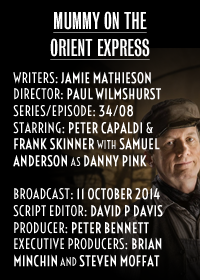
TV: Mummy on the Orient Express (Newsom)


review by Tom Newsom (Twitter | Flickr | Blog)

Sixty-six seconds to sum this one up? Oh, well, it’s set on a train in space, it’s a claustrophobic monster movie, the Doctor’s got to work out how the monster works in order to stop it. There’s a big starry cast, great design work, and it rolls along. It’s smart, it’s quite memorable, and the mummy’s really terrifying and oh crumbs, I haven’t even finished yet...

This episode does everything that Doctor Who should be doing. It’s a slick, classy, classic, traditional adventure. The title appears to give away the tone from the off - Agatha Christie meets horror, and it does them both splendidly - but this is smart and ingrained and Doctor Who in its own right. In forty five minutes, much of the Orient Express setting is background detail, but what detail - a futuristic art deco setting, updated without any fanfare, played straight and solidly. Even the sweet anachronistic cover from Foxes (nice to know there’s someone else who’s picked an unwieldy nickname) screams anachronism but in a fun way. It wouldn’t take Jo Grant long to realise this isn’t on Earth, even without any rubber headed aliens.

The train going through space is wonderful fairy-tale imagery, but the straight-out-of-a-horror-film mummy feels both incongruous and very real. Often shot through a varifocal lens to only pick out the gruesome details, it shambles along unstoppably and unknowably. It even looks creepy when it’s in the background behind somebody speaking. And if you listen closely you can hear Robert Holmes cackling as it sticks its rotting fingers through the Doctor’s head. There’ll be nightmares again tonight.

I love a good mystery, and I love a well-plotted episode of Doctor Who. The plot could be described as traditional - the companion and the Doctor get split up for most of the action, which is a rarity nowadays - but it’s pacey, it’s well condensed. The explanation for the mummy is far cleverer than most too, as well as being thematic for the rest of the season - we’ve had so many soldiers turn up so far, the Doctor should be kicking himself for not getting it sooner. It’s hardly guessable, that misses the point and the thriller genre this tries to fool you into thinking it belongs to, but it makes good sense. Again, the ending skips over the boring bits after the monster is defeated and, intentionally or not, adds another layer of mystery to the Doctor. Like Clara, we could almost believe he left everyone else to get burned up - after all, he did so in Time Heist!

I try not to make too many comparisons to old episodes of the show, but I’d compare this one with The God Complex from a few years back, with another mysterious monster in a familiar setting bumping people off (completely coincidentally, both by writers of Being Human!). Only, this story felt more fun somehow, with the characters and design ramped up to absurdity, the idea of a scary semi-invisible mummy being on board made the episode a whole lot sweeter. It’s the epitome of a show that knows it’s often ridiculous but steams on with perfect judgement and direction. The God Complex notably went for full on tension - hello again 12 rating! - and the Doctor and his companions railing against not being able to stop the piling body-count. Here it’s done subtler and therefore becomes more palatable. This Doctor doesn’t - immediately - care for every single life, especially if he knows they’re going to die anyway. The show rightfully doesn’t ask us to mourn for people we’ve hardly seen, nor does it play it for laughs. It’s that right tone of serious flippancy that people want - from Doctor Who, from episodes of Poirot and Miss Marple too.

Because like Poirot, there’s a big cast of actors in small roles, though each has a niche and a character and a chance to shine - Christopher Villiers, David Bamber, Daisy Beaumont - even Janet Henfrey, playing another old bat, who’s only in it for precisely sixty-six seconds! John Sessions provides a great ‘who’s that?' voice to ponder, pleasantly not sending up the upper-class computer voice. And Frank Skinner nails the delivery of each line, especially the jokes - although not at the end, as that man clearly wanted to stay on board the TARDIS forever.

And then there’s Peter Capaldi, who is given tons to do this week, tons of emotions and character. I think I liked him in this episode more than any of the others, with just the right combination of facets shown here: he’s a Doctor who’s snarky about people dying and big scary monsters but not flippant, and who might not have a plan but whose hearts are in the right places. Given that this episode was written after the character was cast, unlike some of the earlier episodes, I’d be happy to see this being the ‘definitive’ Twelfth Doctor if such a thing will exist, much in the same way that The Lodger seemed to set a new mould for writers to work with for Matt Smith’s Doctor.

With the Doctor taking most of the action, Clara plays second fiddle, though notably not the traditional companion role of running after him asking questions. And curiously, I didn’t think that she was going to be in this - why would that be deliberately kept quiet? Perhaps to make the ending of last week’s look final? She’s subtly different from the start, which added to the confusion, not quite letting herself get involved and become won over again, and happily gets a chance to talk things over with Daisy Beaumont’s character. Both the episode and her arc in it seems to be reaching out to the people who complained last week saying: “this is why you love it, honestly.” Clara is our audience identification in this, in that we’d want more after seeing this particular adventure. The writing is clever: this time it’s presented as an addiction for her, which fits in with all the life juggling we’ve seen so far. Clara can’t give it all up and never see this man again any more than we can.


review by Tom Newsom (Twitter | Flickr | Blog)

05 October 2014

TV: Kill the Moon (Tom Newsom)


review by Tom Newsom (Twitter | Flickr | Blog)

“How would you like being the first woman on the Moon?” the Doctor tells realistic schoolgirl Courtney, and with that we’re taken into this week’s adventure which definitely gives you something to think about.

The episode promises Aliens but gives us a discussion on murder, or even abortion. The Ark in Space stuff is almost window dressing - admittedly the best looking window dressing we’ve had in years, as the volcanic Moon landscape being awe inspiring. Filming in bright rocky Lanzarote rather than a quarry or sandpit was a great choice, as is the muted grey/orange colour scheme. And it’s not just the visuals that are gorgeous, the direction overall is strong and the tone is tight. There’s mystery, there’s some proper scares from the ‘spiders’ and cobwebbed corridors (textbook creepiness), there’s funny lines too - but the episode, and the plot, is centred on the decision whether or not to ‘Kill the Moon’ rather than the visuals.

It’s not every day that the series goes all philosophical, though there are examples in recent years - The Beast Below had a similar, if less bleak, scenario, and The Waters of Mars featured another pioneering but doomed space crew. But this feels genuinely new territory for the show in a similar way as Listen, perhaps because it’s written (superbly) by a new writer to the show, Peter Harness. The default setting this series is ‘deep’: every episode has big running themes in the background, complex main characters (plural), nuanced motivation and grey areas, even more pronounced than in Moffat’s earlier Who. These are big, brave questions (do they have the right?) that sci-fi can do so well, and this one sticks in the mind.

And especially brave is that it’s an episode that didn’t present one clear view for us to root for - not even Clara was sure of the correct decision. Admittedly I wanted to see more of the ‘spiders’, certainly more of the threat that this creature apparently posed, more than a hologram and a description of life back on Earth. But all it needed from the other viewpoint in the end was the understated bleakness of the scene of Earth reacting to Clara’s impassioned speech by switching off their lights, by wanting to kill the thing that is killing them. It seemed a very realistic view of a future Earth (though a bit unfair for only the half of the world that’s in darkness to be able to vote, no?), if lacking in humanity. It’s a trait also evident in Hermione Norris’s quietly strong performance as the suicide-mission leader (she looked natural in a spacesuit to me, or maybe I’m just remembering Outcasts), and of course the Doctor.

He’s adopted a policy of not caring, and still remains an unknowable rather than truly unpredictable figure, a walker in eternity and above humans, whether they’re astronauts, scientists, schoolteachers or children. It’s bringing the character’s more alien traits to the forefront, but with the benefit of strong writing and acting that makes it more interesting than ever. And again, what the Doctor knows and decides to tell us affects the story (the dilemma changing to killing a living creature rather than a lump of rock), a bit like the problems in Listen, in Time Heist, and his reluctance to share information in The Caretaker.

Which means Clara’s exit at the end of this episode comes more out of the blue, this episode being the final straw after similar dangers in a series where some viewers have questioned why she kept travelling with this new Doctor. It’s written as cleverly and as complex as the rest of the episode: it’s the Doctor’s automatic faith in her to be the best of humanity that is pushing her away. Clara’s grown into a fully rounded, flawed character and perversely that means that she isn’t ‘companion material’ any more, unlike many of her predecessors that apparently put up with it. She’s not special.

Jenna Coleman sells this change for us perfectly - I’m sure everybody else must have teared up from seeing her and the Doctor’s reactions - and she’s more downbeat earlier in the episode too, with Courtney getting most of the quirky lines. It’s a natural performance of someone who isn’t comfortable with travelling with the Doctor, and this time she’s being pushed too far. Her scene with Danny Pink at the end is glorious (so reassuring to see him again, especially back to nice accepting mode) though painful for her. To use Tegan’s words, “it’s stopped being fun”.

But isn’t that a downside to this episode of Doctor Who, a lack of fun? There’s the dry coldness of the setup (more manufactured than most - it’s a big sell that we’re rushed into very quickly at the beginning) and a general lack of humanity as well as a lack of action. Certainly very little has changed physically by the ending - Clara cleverly second guesses the idea that they can’t destroy the Moon, but in the end, it’s still there - is that an anticlimax? The Doctor’s speech and the scenes at the end help cover up the lack of impact on the rest of the world or other characters, but the story only really affects Clara - and even that’s down to what the Doctor didn’t tell her rather than the scenario itself.

And even in the less philosophical episodes like The Caretaker, there’s been a huge increase on sniping between the main characters, which isn’t to everyone’s taste. After the previous episode, splitting the Doctor and Clara up at the end here in a complex fashion feels like it wants the audience to pick a side: is Clara being selfish, or is the Doctor? Viewers can all too easily fall into the trap of disliking the main character or the hero, and then it can be not so fun anymore, even if it is interesting to watch.

That is, unless viewers (and reviewers!) simply accept that this new show is ambiguous - science fiction and fantasy with gloriously deep drama, telly that you can get out of it whatever you want, depending on how much you want to analyse it. It might not be to everyone’s taste, but I think it’s a bold, certain step for probably the most analysed show ever. A series that can have Time Heist, The Caretaker and Kill the Moon one after another - mad ideas, character drama, action and scares and food for thought, and always always craziness - it’s why we love Doctor Who.

Because next week: killer mummy - in space!


many thanks to
Tom Newsom (Twitter | Flickr | Blog)