Showing posts with label Jamie Mathieson. Show all posts

18 October 2015

Doctor Who: The Girl Who Died


In terms of eye-catching imagery, this one grabs your attention. “Doctor Who meets Game of Thrones!” says the Radio Times (slightly superficially, given the actual episode). “Vikings Vs Aliens!” cries another. And if you’re thinking that it sounds fairly typical for the series, this story takes a simpler plot, tells it well, and makes good use of the extra room for smaller, snappier scenes. After the spooky but rather scientific investigations of Under the Lake, I liked this one even more. It’s my kind of Doctor Who.

It’s also yet another take on an established genre. No, not Vikings, but the classic, Western movie trope of a village being under siege and having to train up the villagers to beat the invaders. Not that it’s the first time it’s been used in Doctor Who. Having the Doctor gatecrash another type of story is one of the show’s staples, as it allows everyone to have some fun, and it’s the only type of show that can get away with it so often. This episode has some fun with it, with the Doctor training up the villagers and doing his best army general impression. But mostly, it’s played for real. He knows full well that the villagers are going to die (he argues they have to die, using his logic, because otherwise it will cause too many ‘ripples’ in time). The odds are against him more than ever in this impossible situation.

If that sounds less action packed than most stories, you’d be right. The story breezes along rather nicely, with some steady direction. After a fast paced introduction where we’re (very) speedily thrown into the situation this week, the story settles down into... introspection. The Doctor isn’t a fighter - actually, there’s very little fighting in this story at all! - he’s a thinker. And when the enjoyable and especially funny quips die down, there’s a rare chance for the show to delve a bit deeper into the characters than they usually do in recent years. Or have the Doctor and Clara talk about weightier issues.

The standout emotional scene in the middle of the story is the Doctor ‘talking’ baby. It’s taking what was presented as a joke from previous episodes, and perhaps being inspired by Peter Capaldi translating the dinosaur in Deep Breath too. The sound of a baby crying alone didn’t work in sparking the village into action, so the Doctor translates it into language and it becomes sweet and sad and a glimpse into an unknown world. All of this in a few spoken lines - and it’s enough of a moment to hang the rest of the story onto it.

I feel sorry for the new aliens, though. The Mire look and sound pretty cool, and the design does a lot of the work for them. But they don’t get much of an outing in this episode, when most of it is devoted to the Doctor and Clara. Pitching them as Viking-like in morality makes them stand out from the rest of the show’s pantheon straight away, even though we know very little about them otherwise.

The episode strives to be entertaining, with the Doctor on fine form. This week Peter Capaldi is cast as a mad god and a rational thinker rolled into one, and a goofier side to some of his humour. As ever, he feels unpredictable - hell, this Doctor feels like Tom Baker, having that alien aloofness of not caring for human matters, masking the love of the trivial, and deep friendship with his companion. Clara, you could say, occupies some of the more traditional role as she’s becoming more like him - she can stand up to the aliens too. But also she’s definitely got that shared bond with the Doctor as they understand each other much better. (All the more important to keep those talky scenes rather than reduce it all to shorthand)

It’s Doctor Who on strong form - reminiscent in broad terms of last year’s Robot of Sherwood (down to some of the expansive sets and the sunny look), but even more successful, if a more sketchier drawn setting. The Viking setting is a catchy look, but populated with everyday characters, with more detail being sketched in with new girl Ashildr. She’s cleverly played as just a normal, quiet young girl, but cleverly written to make her more Viking and less modern and immediately likeable. Her strengths are slowly revealed, and they are in her character rather than in her funny quips: her heart, her storytelling, her innocence. It’s a good role to build a story around.

For all the build-up to this particular episode, overthinking fans might feel a bit underwhelmed by the result. Sure, Maisie Williams’s casting is exciting, even when you discount the theories as to her character - cue the inevitable list of old friends and foes. But the episode itself (titled The Girl Who Died!) acknowledges that her character will be important right from the start, even if it cheekily puts the Doctor’s interest in her down to a premonition - “remembering in the wrong order”. Looking back, it’s pure mystical foreshadowing, but at least we can be comforted in the knowledge of another 45 minutes continuing the story next week.

19 October 2014

TV: Flatline (Newsom)


review by Tom Newsom (Twitter | Flickr | Blog)

It’s new territory for Doctor Who, or maybe it’s a return to an old staple. After last week’s upper class art deco spaceship, the show brings us right down to earth to a council estate. In Bristol. It’s never really acknowledged a world of community service and graffiti, but the episode breezes past that and straight into a big old monster movie. It’s more Misfits than the Powell Estate, and a lot like Attack the Block. And putting aside the unique monsters and how it gets the Doctor out of the picture, Flatline is refreshingly low concept - and like most of this series, refreshingly free from the history of the series. It’s Clara on an adventure trying to beat the monsters and protect people.

It’s obvious that by separating her from the Doctor, Clara gets lots to do here. The latest in her arc plot ties up and moves forward the discord of the last episode. Their continuing relationship was left mostly ambiguous last time, and that continues this week as she takes on the traditional lead role. Her struggles to lead her team of survivors and protect them is making her get closer to understanding the Twelfth Doctor, but his noticing those changes troubles him. It’s Frank Skinner’s “this job could change a man” line writ large: is Clara lying to herself, as well as Danny and the Doctor? Or being selfish and, well, Doctor-like? However the series decides to continue it, it feels great that Clara herself is at the heart of her own story this year (if that’s not a tautology for the Impossible Girl).

Whilst Clara takes centre stage, that doesn’t mean the Doctor isn’t there: he’s in the background talking to himself and giving a snarky running commentary on it all. The writer, Jamie Mathieson, has proved he has a great sense of irony that fits in with the best that Doctor Who has to offer. The Doctor’s situation isn’t exactly played for laughs but it’s often very very funny, exploiting every visual gag it can. It’s the sort of setup which sounds bonkers on paper in a bad way, and looks bonkers on the screen in a good way. The effects are often pleasingly low budget (hands sticking out of model TARDISes, false perspective on the actual TARDIS set), clever solutions to what was no doubt a whole load of directorial headaches.

That contrasts with the ultra cool monsters the Boneless who take all sorts of forms as they try to push themselves into our world. These make for some great set-pieces, particularly a perilous moment in a living room that makes a perfect ‘playground game’ out of the episode. The rippling monster effects look absolutely beautiful, and the rest of the episode looks very stylish too, something hard to do when it’s not all space galaxies and starlight. Both the 2D and 3D incarnations of the monster are creepy, with the latter reminding me of badly sculpted toys, uncanny valley style. Like many previous episodes in the series, the sound effects make it all the more creepy.

It’s an episode that feels traditional on the surface - it’s the Doctor and Clara against scary monsters. And that’s not even a criticism, we haven’t had that sort of story in ages. But there’s plenty more to enjoy, a very new configuration of the show that does everything at once. Hilarity mixed with horror, fitted snugly into forty five minutes, which makes this an exquisite bite of Doctor Who.


many thanks to
Tom Newsom (Twitter | Flickr | Blog)

12 October 2014

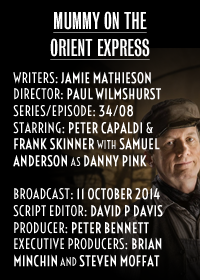
TV: Mummy on the Orient Express (Newsom)


review by Tom Newsom (Twitter | Flickr | Blog)

Sixty-six seconds to sum this one up? Oh, well, it’s set on a train in space, it’s a claustrophobic monster movie, the Doctor’s got to work out how the monster works in order to stop it. There’s a big starry cast, great design work, and it rolls along. It’s smart, it’s quite memorable, and the mummy’s really terrifying and oh crumbs, I haven’t even finished yet...

This episode does everything that Doctor Who should be doing. It’s a slick, classy, classic, traditional adventure. The title appears to give away the tone from the off - Agatha Christie meets horror, and it does them both splendidly - but this is smart and ingrained and Doctor Who in its own right. In forty five minutes, much of the Orient Express setting is background detail, but what detail - a futuristic art deco setting, updated without any fanfare, played straight and solidly. Even the sweet anachronistic cover from Foxes (nice to know there’s someone else who’s picked an unwieldy nickname) screams anachronism but in a fun way. It wouldn’t take Jo Grant long to realise this isn’t on Earth, even without any rubber headed aliens.

The train going through space is wonderful fairy-tale imagery, but the straight-out-of-a-horror-film mummy feels both incongruous and very real. Often shot through a varifocal lens to only pick out the gruesome details, it shambles along unstoppably and unknowably. It even looks creepy when it’s in the background behind somebody speaking. And if you listen closely you can hear Robert Holmes cackling as it sticks its rotting fingers through the Doctor’s head. There’ll be nightmares again tonight.

I love a good mystery, and I love a well-plotted episode of Doctor Who. The plot could be described as traditional - the companion and the Doctor get split up for most of the action, which is a rarity nowadays - but it’s pacey, it’s well condensed. The explanation for the mummy is far cleverer than most too, as well as being thematic for the rest of the season - we’ve had so many soldiers turn up so far, the Doctor should be kicking himself for not getting it sooner. It’s hardly guessable, that misses the point and the thriller genre this tries to fool you into thinking it belongs to, but it makes good sense. Again, the ending skips over the boring bits after the monster is defeated and, intentionally or not, adds another layer of mystery to the Doctor. Like Clara, we could almost believe he left everyone else to get burned up - after all, he did so in Time Heist!

I try not to make too many comparisons to old episodes of the show, but I’d compare this one with The God Complex from a few years back, with another mysterious monster in a familiar setting bumping people off (completely coincidentally, both by writers of Being Human!). Only, this story felt more fun somehow, with the characters and design ramped up to absurdity, the idea of a scary semi-invisible mummy being on board made the episode a whole lot sweeter. It’s the epitome of a show that knows it’s often ridiculous but steams on with perfect judgement and direction. The God Complex notably went for full on tension - hello again 12 rating! - and the Doctor and his companions railing against not being able to stop the piling body-count. Here it’s done subtler and therefore becomes more palatable. This Doctor doesn’t - immediately - care for every single life, especially if he knows they’re going to die anyway. The show rightfully doesn’t ask us to mourn for people we’ve hardly seen, nor does it play it for laughs. It’s that right tone of serious flippancy that people want - from Doctor Who, from episodes of Poirot and Miss Marple too.

Because like Poirot, there’s a big cast of actors in small roles, though each has a niche and a character and a chance to shine - Christopher Villiers, David Bamber, Daisy Beaumont - even Janet Henfrey, playing another old bat, who’s only in it for precisely sixty-six seconds! John Sessions provides a great ‘who’s that?' voice to ponder, pleasantly not sending up the upper-class computer voice. And Frank Skinner nails the delivery of each line, especially the jokes - although not at the end, as that man clearly wanted to stay on board the TARDIS forever.

And then there’s Peter Capaldi, who is given tons to do this week, tons of emotions and character. I think I liked him in this episode more than any of the others, with just the right combination of facets shown here: he’s a Doctor who’s snarky about people dying and big scary monsters but not flippant, and who might not have a plan but whose hearts are in the right places. Given that this episode was written after the character was cast, unlike some of the earlier episodes, I’d be happy to see this being the ‘definitive’ Twelfth Doctor if such a thing will exist, much in the same way that The Lodger seemed to set a new mould for writers to work with for Matt Smith’s Doctor.

With the Doctor taking most of the action, Clara plays second fiddle, though notably not the traditional companion role of running after him asking questions. And curiously, I didn’t think that she was going to be in this - why would that be deliberately kept quiet? Perhaps to make the ending of last week’s look final? She’s subtly different from the start, which added to the confusion, not quite letting herself get involved and become won over again, and happily gets a chance to talk things over with Daisy Beaumont’s character. Both the episode and her arc in it seems to be reaching out to the people who complained last week saying: “this is why you love it, honestly.” Clara is our audience identification in this, in that we’d want more after seeing this particular adventure. The writing is clever: this time it’s presented as an addiction for her, which fits in with all the life juggling we’ve seen so far. Clara can’t give it all up and never see this man again any more than we can.


review by Tom Newsom (Twitter | Flickr | Blog)