Showing posts with label Julie Gardner. Show all posts

13 March 2015

TV: Banana viii


And so we come to the end of Cucumber's little sister show. Banana has come in eight weird and wonderfully diverse packages, topped off with a callback to both the third episode of the series, and the last two of Cucumber. But you needn't have see any of those three marvellous pieces of television to enjoy this spellbinding climax. 

Vanessa is a contract industrial cleaner, who employs Jonjo to source labour. Many of his subjects are of course immigrants, but these are young girls from Africa. When one reaches out to Vanessa, telling her what he's done, and asking for help, there's a caustic reaction to say the least. From Vanessa's good nature in Sue Perkins' excellent episode earlier this series, viewers can be fairly confident that she'll make things right in the end somehow. 

Over the course of fifteen minutes or so, dedicated entirely to strong actresses Lynn Hunter and Nikki Fagbemi, the pair learn to communicate in a method transcending language. Vanessa is furious that Zara has told her about it. She's known about it for years, but now the hard decision comes as she's forced into action by the rules of television. There's a lovely little number at the end too. And there's a sting in the tale that'll leave you with a massive grin across your face.

It must be said that this episode really doesn't fit the format established by the preceding seven, including two by Davies himself. In a way, it resembles the others in that it forces the protagonist/s to take a stand and do what they feel is right. But there's no love story here. In our last ever visit to the Calico Flats, they're transformed and there's hope on the horizon for Vanessa's workers, with the possibility of moving in.

Banana's been an odd little series, often only loosely linked to the main show, but I've loved it. It's delivered exceptional drama, admittedly not quite on the scale of Cucumber, but great nonetheless. It's pushed the boundaries of modern TV, and has been unashamedly frank in its storytelling. The best four episodes for me were the first three (chronicling Dean, Scotty and Sian) and the sixth (written by and starring Charlie Covell) but there's been moments in all of them that I've liked.

I'm very grateful to everyone who worked on this interesting little series for brightening the TV landscape. While change will inevitably slow, hopefully this series, along with its sister programme, have started something of a revolution. That said, Queer  as Folk made barely any lasting impact, as well as that was received. We can live in hope. If this was all it was meant to be, that's still great. 


TV: Cucumber viii


Here we go one last time then.

That's much how writer/creator Russell T Davies seems to approach this episode to me. This may well be his last chance to say what he wants to so publically and so truthfully, and I'm sure he knows it. The eighth, and final, episode of Cucumber sees Davies' signature storytelling style used in miniature, as Henry tries to surround himself with friends to help him forget what's missing.

As well as the Collective - the former inhabitants of the Calico flats moving into Henry's house - works, it disbands before too long and we're left once more with just Best, Freddie and Cliff. In Davies' (and Benjamin Cook's) phenomenal The Writer's Tale, there's an illustration of what he would've wanted the Doctor's son to look like, had 2008 Doctor Who episode The Doctor's Daughter been taken down a different path. The picture, and accompanying description, seem to fit Freddie Fox perfectly, and I don't wonder that the character was reimagined for Cucumber.

Con O'Neill is once again excellent as Cliff, and in this role ascends to my third favourite of the series. He's wonderfully witty and wry, and the idea he's anything other than perfect for the role as imagined by Davies should be dispelled. However, there are two frankly fantastic performers who just edge him out. Julie Hesmondhalgh is undoubtedly best known as Hayley on Coronation Street, but from now on it'll be hard not to think of her as Cleo. She's embodied the part that's often been labelled the voice of reason in a series full of mad events and decisions and made it her own. It really is coincidence that the best episodes of the series - the first and sixth - are the two that don't feature her, since she's truly excellent.

This series is made entirely by Vincent Franklin as Henry, though. He is perfectly cast in the role, being able to articulate the every whim of Davies with flair, ease and - most importantly - excellence. This episode is no different, and the final scene shows him off at his best again. Indeed, the sincerity of the final line stays in the mind long after the credits roll. It's an oddly profound note to end on, but in a way that's entirely appropriate of this series. It made me think a lot, and clearly I'm not the only one as - most prominently - Gareth Roberts also tweeted about its truth. I think there can be no argument that in narrative terms Cucumber has been stunning. 

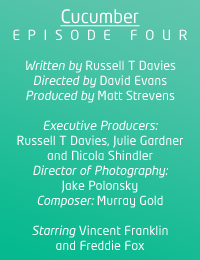
There are many to attribute its success to of course. Davies is naturally the main driving force behind the show, but if I start praising him I'll be here all day. Suffice to say his skill in executing both long and short-term storylines and narrative tricks still remains unparalleled in my eyes. His co-executive producers Julie Gardner and Nicola Shindler need a hearty thanks, and I'm so grateful to Piers Wenger for commissioning this at all. The directors have all been beyond amazing too, and Jake Polonsky has kept things looking beautiful. Beyond the actors mentioned above, James Murray (Daniel), Fisayo Akinade (Dean), Letitia Wright (Scotty) and of course Cyril Nri have all been inspirational. 

Behind the cameras, there's been some highly commendable work that I've barely mentioned. Louise Page is another face familiar from Davies' BBC Wales days, and I must say all her costumes have been right on the money. Dean's yellow hoodie, for example, sums up the character perfectly. Murray Gold has been amazing, and if there was any doubt he had a great ear for basslines (I can still hear Westminster Bridge whenever I want), Cucumber has set them straight. His choral pieces were my favourite, but the whole series has been excellently scored from start to end. And Mark Adcock has done excellent things as a camera op for all eight episodes. Having tried this myself, I know how much of an art it is, and the way Adcock and co. make it look so effortless is truly a skill. 

And a huge thank you to all the electrical, make-up, art and sound departments that have made this so special. This will go down as one of my favourite series, thanks to everyone involved. Andy Pryor's casting can't go unmentioned, for making it such a success. And I'm sure none of it would have happened without Matt Strevens. So thanks all. 

Beyond all that, though, Cucumber's given me a new catchphrase - a Henry-style "oh fuck off!". And really that's what I direct at all the naysayers the series has accumulated, few though they are. Thanks Russell, Vince, it's been fucking amazing. Cucumber's taught me a lot, but really it's underlined one thing I was already fairly certain of. 

Men are mad.


06 March 2015

TV: Cucumber vii


There's a few ways to go following a death. Russell T Davies' choice sits perfectly well with me. However much we can now see the first six episodes of Cucumber were the story of Lance, it's always been about Henry. Following the death of a loved one, most of us are something of a mess, especially emotionally. The seventh episode in the series follows Henry as he struggles to come to terms with his loss. I've read reviews complaining that this is an inconsistent episode, but that seems to be entirely the point to me. Grief, like love, is like no other emotion, and everyone handles it differently.

We begin at Lance's funeral, where Henry resents the deceased's sister Marie revelling in all the sympathy. He retires to the safety of his friends, and I'm pleased to say the marvellous Con O'Neill as lawyer Cliff features very prominently in this episode. This is an illustriously heady mix of emotions like you've not seen before. There's much sorrow as Henry balls his eyes out, lust as he and his flatmates chase down a man with a little help from Grindr, anger as he rages at Marie, and finally ecstasy in the closing moments.

The scene between Freddie, Dean and Henry in the car as they wait for a shower to pass is one of those that should go down as a writing masterclass. Davies proves once again how good he is at writing characters trapped in a confined space - as he has rightly received much acclaim for doing in Doctor Who's Midnight. At the top of the episode, we see Freddie ready to leave the flat, to move into a place that's more expensive, smaller, but with better prospects of sex. Slowly though, he reverses that decision and really grows up from the hedonistic thrill-seeker we were introduced to at the start of the series into a young man more focused and driven. His girlfriend seems to have been forgotten, but that's understandable really. 

There's so many superb scenes in this, and I think Vincent Franklin must be in every single one of them. A lot is demanded of him, but as always he more than rises to the challenge. I can totally understand Davies' comments in a video interview for Channel 4 that he knew he had his Henry as soon as Franklin entered the room. He embodies the character, and makes him one of my favourite of all time. The scene in the bar (the same one as in short tie-in drama Screwdriver?) between him and Marie is icily electric. She comes across as a real bitch, thanks to a solid performance from Adjoa Andoh, and it's oh so satisfying to see her storm from 'her' house at the conclusion.

I knew the flats were going to play a part towards the end of the series. How, though, I couldn't have predicted. The mystery of the cheap rent was built up so much over the opening episodes, I could tell it was going to come back to bite our leads. And indeed it does as 'Roderick' decides to reclaim everything on his property. The scenes of Henry standing still, watching barefoot as the shit hits the fan, are just mesmerising. In an unmentioned twist of irony, it may well have been better for Freddie if he had moved out after all.

It's so good to have Euros Lyn's work back on our screen. There's several memorable high shots in this episode, and he accurately captures the scale of every scene. I know I've praised him every week, but Vincent Franklin is once again the star of the show, and Con O'Neill is just fantastic as Cliff. There's no supermarket scene here, because things have moved on. Although it must conform to TV standards to some extent, I love how much of a natural flow Cucumber has. Events that would normally be saved for a finale surprise the audience two episodes early (was I the only one wondering whether there'd be a marriage, not a death, by the way?), leading us to question just how big Davies plans to go next week. The final scene really does feel like the end of the series, so I can't wait to see where Cucumber goes in its last ever (sob!) episode. 


27 February 2015

TV: Banana vii


This is something of an oddity, even amongst Banana episodes. Unrequited love is a topic that hasn't really been covered - it could be argued it was briefly with Josh and Sophie in episode five, but it was hardly the focus. Here, Frank ends up in a threesome with the more conventionally handsome Ben and Aidan, and pursues the latter the following morning, looking for something more.

The pair flirt with the idea for a morning - we even get to flash forward nine months - but ultimately hunky Aidan ends it. They were clearly never meant to be though, with Frank more invested from the start. At first, you think it will work out, Aidan will drop his prejudices, and they'll live happily ever after, thanks to the general shape of the series so far. But unfortunately, it isn't to be.

Instead this ends up as both a cynical and an optimistic commentary on modern society. Cynical because of its sleight against modern values, and not appreciating the opportunities we're given. Rushing into things without full consideration. Aidan just can't go out with someone that he doesn't find physically attractive, and that's fine. Some people are just like that. But so much prominence is devoted to that topic that I can't help but feel it was an intentional stab by the writer. And to address my second proposition, I find this optimistic because it tells us that any day - every day - could be day one. You might find the person you're supposed to be with any day, and that's a magical notion. 

Luke Snellin's episodes seem to have been those that are slightly off-kilter for me. That's not to say they're bad, but they're certainly the exceptions of the series - if a series as varied as this can have a norm to deviate from. The final episode of the series looks to be a whopper, and I for one can't wait. This has been a very interesting series, one that's dared to push the boundaries in all the right ways, and I'm so grateful we got it. The quality of storytelling we're getting here is pretty much unparalleled in today's television landscape. Trust Davies to be the one to broaden our minds - again. 

Excellently made, but lacking a certain something.


TV: Banana vi


Charlie Covell returns to script her second episode of the series, and also stars as the main protagonist, Amy. Right from the off, we're shown everything we need to know about her. She's performed extremely well by Covell, and it's clear that the writer knows her character inside out, adding little tics to the performance. I really liked the way this was subtly package as a day in the life for Amy as she bounces from home to work to dinner, all the while scared stiff that everyone she sees will drop dead if she doesn't do all she can.

After a few minutes' adjustment, I found Covell to be really quite endearing in the role. This is half an hour of character drama with one of the most likeable characters Banana has presented us with. We've all had the moment where we clam up or gabble at the worst possible moment, and Amy gets for an entire evening when she goes on a date with policewoman Kay. Really, Kay is quite peripheral to the whole thing, which is more concerned with showing us that there's someone out there for everyone.

The entire episode is shot beautifully by Al Mackay, yet another director Banana has introduced me to. From his previous work (largely as a location manager) it seems something of a gamble was taken on him by executive producer Nicola Shindler (who I don't praise nearly enough!) and co. It totally paid off me, and indicates that he should have a bright future in this field. The images broadcast were particularly photogenic, but his command of actors clearly isn't slack either. The moment in the last scene where the buildings around our two leads light up was electric. In the preceding moments, that's exactly what I was imagining I would do. It's a rare occasion when I actually second guess what's coming next, so this was quite pleasing.

Although there wasn't any tangible jeopardy in this episode was as with, for example, Bethany Black's a couple of weeks ago, the will she/won't she of the date (and following it) is made into more than enough of an event. TV focuses on the small moments that mean so much to the individual, making this series especially refreshing. Something of a recurrent theme creator Russell T Davies likes using is asking how bad things can get. Most recently, this has been 'how badly wrong can a date go?'. For Cucumber lead Lance, episodes one and six of the parent show have answered that, one ending with his arrest, and the other with his murder, briefly mentioned here. It's nice to see Amy appear to completely mess things up, only to still get the girl in contrast to the expectation created by Davies.

This is one of the stronger episodes of the series, which is saying something. Covell writes economically and succinctly, but still manages to convey wholesome characters and situations. The closing moment is one of joy and adrenaline in the best sense. The feeling that anything could happen next is positively tangible, and accompanied by a typically pacey and appropriate soundtrack from Ben Foster, it's hard not to be moved. If only we could all have nights like this. Standout drama once again from Team Davies; I love it.


TV: Cucumber/Banana/Tofu vi


reviews by Tom Newsom (Twitter | Flickr | Blog)

I watched this a couple of hours ago, and I’m still shaken by it. It’s a beautiful episode, hardly a tough watch in that regard, but god, it stays with you.

Look, just watch it. If you haven’t already - you don’t even need to see the rest of the series really, it’s pretty stand-alone. And in the context of the rest of the series, this seems to be the big one. So, give it a watch - you won’t regret it.

I’m going to be very vague, even though I don’t need to be. Because the set-up before the opening titles lets us in on its secret just enough to set the tone of what’s to come: poignant, tense, often quite dangerous, true.

I’m amazed that this episode was conceived alongside the others. The bouncy comedy that made up some of the previous episodes was written with this in mind, it was acted and shot and edited too. Though of course, this still has the same bounce. The humour becomes black humour, thanks to that dangerous mood lingering over it all.

God. Leaving aside the perfect, inventive acting (Cyril Nri in particular) and everything else, this is the sort of episode that is defined by its writing. If somebody only recounted the plot, it would miss every point there is (and probably turn some of it into issues that aren’t there). This is impeccably handled. What sets it above is the investment we’ve had in the last five weeks (not knowing a thing - consciously!), plus the investment put in to this episode when recalling somebody’s life history in fifty minutes. And then, dramatic scenes, layers and layers of it. And an ending that will shake you and make you cry.

This is a must-see. And afterwards, read this incredible online interview with Russell T Davies.


This week’s Banana is cannily placed, offering a breezy antidote to what’s just happened on the other channel, but with a darker side that fits with the parent show. The link this week appears more tenuous - I don’t think these characters are even in it, at least not this week - but the theme of sudden death comes up over and over.

Because the main character here has anxiety and OCD (at least, that was my interpretation). After six episodes I’m realising that this is, happily, a character based show rather than relying on plot. Last week’s was blissful even when nothing particularly was happening - this episode feels the same. What’s more it’s striving to put people centre stage that don’t normally get focussed on, like most ‘teen’ dramas really.

Amy (played and written by rapidly rising star Charlie Covell) has a date with Kay (a policewoman with few lines but big impact), but is trying to get over her own problems first. It’s quirky rather than mawkish, cute rather than sexy, and the final scene is absolutely lovely.


Tofu luckily doesn’t fit with the theme here. Although there’s some talk of the episode of Cucumber above - you’d be hard pressed to escape it.

This is the episode that felt more like a behind-the-scenes (mostly cast interviews and a lot of clips of the other two series, admittedly well chosen). Which is fine, but this one goes for the widespread general question of: ‘what’s it like filming sex scenes?’. As well as watching and writing - hey, it’s Russell, hooray!

There’s also clips and discussion of Queer as Folk - not massively, but tying all the series together.


many thanks to
Tom Newsom (Twitter | Flickr | Blog)

TV: Cucumber vi


Bloody hell.

20 February 2015

TV: Banana v


Conversely to our other reviewer, Tom Newsom, I felt curiously unmoved by this week's episode of Banana despite it theoretically being more relatable for me. Law student Josh (Luke Newberry) returns home from Manchester to the sleepy countryside where he grew up for his oldest friend Sophie's wedding, but when he meets the groom, he's less than thrilled. Both of these two central characters are only eighteen, so it does seem a little soon for two especially hedonistic characters to want to settle down. 

Despite what Sophie thinks, there is a lot of evidence, even in this episode, that she is impulsive. To name just two instances, she hired the car at Josh's expense without asking, and she doesn't want to get married just as quickly as she did want to get married.

Josh and Sophie never really seemed to hook me in. Their relationship is appreciable and engaging enough, but there's nothing that really excites me, including the arguments. Don't get me wrong, I can still tell it's quality drama, I just wasn't noticeably moved by it. After the high drama of Cucumber, coming to this breezy, sun-filled episode jars a little. One of the themes of the two series is that love is everywhere, and it's nice to have a break from the usual rough structure to show its extent, and how it's not always experienced in a romantic sense.

One of the strengths of Russell T Davies' writing is that actions have consequences. This episode of Banana is pretty carefree, and so goes against the series' tone a little. However, I can appreciate the strength of the writing. Matthew Barry, fresh from helming the Death in Paradise finale, skips channels and genres without too many hiccups. I like that none of the five episodes so far have put a definite end on their stories. Josh and Sophie's is left more ambiguous than most though, as they sit in a lay-by, eating burgers. Rather than the all-encompassing pool of emotion the closing seconds usually dive into, we end on a single, admittedly amusing, line from Josh.

I can't put my finger on what it was that didn't work for me about this episode. Luke Snellin shot the whole thing in a lovely light,  one that Barry Shitpeas would probably label 'Instagrammy'. Ben Foster's music again strikes a chord, punctuating the action perfectly. There's undoubted quality being piled into this series, it just seems that this episode dropped the ball momentarily for me. Still one of the best things on telly at the moment though.


TV: Cucumber v


As funny as Cucumber is - whether its characters realise it or not - it seems to be edging more and more towards a tragedy, in the classical sense, with every episode. The two main characters - Henry and Lance - are forcing their lives to be increasingly separate, even though clearly neither of them really want it. Of the pair, though, it is ironic that Henry, who was initially the one less keen to settle down, is now missing his partner far more than he is missed.

And Henry can't do wrong for right, either. His little foray into internet videos has left his relationship with his sister burned and his mugs smashed. The scene between Cleo and her brother in her kitchen is one of those great Russell T Davies moments of delivering something completely credible, but completely unexpected as she recounts trauma her daughter has gone through as a direct result of his attempted money-spinner. It's just as well Cleo intervenes and shuts the whole thing down when she does, to be honest, as it seems to be spiralling out of hand. More and more boys are showing up to be in the videos, and they're beginning to question why they need Henry. Indirectly, she's saved his bacon.

Speaking of which, Lance's chances of hooking up with Daniel seem to be improving. After spending a very private evening together, the latter's sexuality is surely being called into question. As Anjli Mohindra's Ronnie Chandra (very original!) posits, it does seem likely that Daniel is at least bisexual, but doesn't know it. I'm sure that realising you're gay is one of the biggest moments of your life, and Banana isn't quite long enough to show us that journey. Taking place over a few months, Cucumber provides the right kind of scale, and how interesting to see a man in his thirties undergo that journey. He clearly enjoys his time with Lance, but the confusion in his mind is just as clearly distressing, leading to certain scenes across the series of him refusing to interact with Lance, deciding it's easier to shut it out. 

I continue to be amazed by the production values of this series, too. I don't know whose idea it was, but the imagery of Henry in the forest is stunning, visually and metaphorically. One of the things I've loved about this show since the beginning is how bold it is, and this episode is no different. I love the little supermarket cutaways at the start of each instalment, and the way Alice Troughton shoots her little expansion, which is neatly referenced at the climax of Lance and Henry's lengthy cafe scene, is superb.

Vincent Franklin is once again staggeringly good as Henry, with his strongest scenes being the two handers with Cleo (Julie Hesmondhalgh) and Lance (Cyril Nri), especially that which closes this episode. The shot as his world finally collapses entirely is quite harrowing. No imagination is demanded of the viewer, Franklin puts it all on display. It's clear now that this was merely a phase for Henry, and he did want to move back home. He's blown his chance though, and has to deal with the consequences of his actions - another sophisticated element of Davies' writing. I can't wait to see where this goes next, but I get the distinct feeling something big's just around the corner...


TV: Cucumber iv


Russell T Davies clearly has a very specific vision for this show, and I for one am totally excited about it. Average writers might try to make their stories bigger by building them around cataclysmic external events, but Davies is such a master of his trade that he knows that from a character perspective, the more satisfying option is to explore the things that matter to everyone - namely the first date.

And so this episode concerns itself for the most part, as the first in the series did, with a single night. We follow Henry, Lance, Cleo, Freddie and Dean as they all go on their separate Saturday evenings/Sunday mornings. These are as varied and amusing as you'd expect from a mind as unconventional as Davies'. Even though some of these evenings may seem 'normal' (Freddie, for example, goes for dinner with a girl before taking her home) but it's the personal journeys all our leads go on that makes this so good.

Henry meets with the date arranged for him by Freddie, and it goes very well. Rupert - the date - is very keen to consummate the relationship instantly, but we know from the last couple of episodes that Henry is nowhere near as eager. Instead, he gets him hammered and they go for a takeaway. At a diner, we get one of the most Russell T Davies scenes imaginable, as Henry and Leigh (a friend of Rupert's friend, who happens to show up) discuss the minutiae of their respective relationships in a cafe. An ordinary cafe. Any cafe. They of course end up in Henry's bed, and it's really nice just to see him having fun for once, after all the stress he's usually under. Vincent Franklin is again amazing, and his acting really is all in the eyes. I noticed this first last episode, when he was watching Adam and Tomas, but it's unmissable here.

Lance goes out with a work colleague, but his love for Henry gets the better of him and prevents him from sleeping with them. In a cab home, he phones Daniel, who ends up inviting him over. There's a very brief shot, but it sums up Davies' writing for me. In interviews, he always mentions that life's about the little things that change your future forever. As he notes, he even wrote an entire Doctor Who story about it (Turn Left fact fans). And sure enough, stopped at a t-junction, Lance makes the decision and the cab goes right instead of left. He ends up staying the night at Daniel's, but nothing happens. I like the sly role reversal of the series - while Lance is apparently the one completely up for it to start with, by this point it's Henry who's off having fun with another man. I expect to see more of this before the series is out.

Cleo meets up with an old friend, Brian, for dinner. But as it turns out, they have more than that planned for the night. Even though Brian's engaged, there's clearly history there, but this isn't as simple as cheating. Cleo just wants a man, after all the trauma she's gone through, and he's willing to give it to her once to help her out. She changes her mind though, wanting to wait for the right man who she can be in a proper relationship with. And Freddie learns that there are other people as open-minded as him, and in Anna he's found someone who he might be happy with. After half a series of being portrayed as the ladies' and gentlemen's man, it's nice to see him attempt to settle down a little, no matter how much he's worried about it.

Dean has possibly the strangest storyline in this episode. Apparently kidnapped, he's soon taken to a house out in the country. It turns out his kidnappers are another couple, and making them big burly blokes called Clive and Boris made me hoot. It's lovely to see things turning a corner at the halfway point of the series, but it's equally a tragedy that we're already halfway through. I know Davies has '80s AIDS drama The Boys coming in the future, but after that I'd love a return to the lives of Henry and co.

While this episode sports a great wealth of talent (including Bethany Black, who I know features prominently in this week's Banana), both in front and behind the camera - Murray Gold and Alice Troughton both contribute massively to this - the relationship between Vincent Franklin's acting and Russell's writing is just magic. Each enhances the other, and as such Henry is my favourite TV character for a long time. This really is the perfect series. I can't wait to see where all our characters are taken next.


TV: Cucumber/Banana/Tofu v


reviews by Tom Newsom (Twitter | Flickr | Blog)

Henry is lost in the wilderness. It’s a fab visual concept to bookend the episode with - a wrong turn leading Henry through the trees instead of that same supermarket. But it’s not just a fancy image, there’s a narrative theme: he’s lost the house, the job, the boyfriend and control over the rest of his life. Even Murray Gold’s music is increasingly offbeat and odd (very different to his usual orchestra style of Doctor Who and The Musketeers - and very good!)

Essentially this is the comedown from last week’s one mad night. The mundane, more realistic romantic encounters where the hope has slightly dimmed: Freddie and Henry was rarely going to spark, even if he enjoys it, whilst Daniel and Lance has turned into something cautious, another power imbalance. Daniel in particular is probably an insane character on the page but played so well (played straight!). Casting all round is a dream.

The standout scene this time is Lance and Henry at the end of the episode - a little like the end of episode 2, but everything has changed. Over coffee and Henry’s attempts to express his thoughts, the conversation shifts so fluidly, with subtle points scored over the other. So much is going on in their faces - it’s an acting tour de force.

And Cleo! Oh, Cleo. The moment where she tells Henry about her daughter and the unintended consequences is electrifying and the right kind of unexpected. And all this dovetails into Russell T Davies’s short spinoff, a scene they’ve filmed between Cleo and her son available online. It’s called Screwdriver - it’s heartfelt, scary and surprisingly close to the mark. It merits a place on TV - but online there’s a chance it’s seen by more people.


Banana is a bit plotless, but oh very satisfying.

I fully understand that this could be personal. The world that’s depicted here is one that I recognise more than the others (not that I empathise with the characters any more, but the actual world - the tech, the language, the relationships). I felt engaged in it too - the plot is thin, yes, but it has a clear view and a message. The ‘old vs young’ theme carries over from Cucumber, along with some of the big dramatic life changing decisions.

Luke Newberry (incredibly briefly popping up on the parent show) from the ace In the Flesh plays Josh, but the episode cleverly is more about Chloe Harris (The Village in particular) as bride-to-be Sophie. I’d watch a show with just the two of them, which is what this often feels like. And it all looks gorgeously sunny with a great soundtrack. Though I think that two scenes of characters wanking is probably enough for one night.


And to Tofu - which shouldn’t really be an ‘and’, it’s a breeze to watch. This fifth episode is sparky and cheeky as ever. Titled ‘Teenage Lust’, it’s a well edited, fast paced look at the first experiences of our interviewees.


many thanks to
Tom Newsom (Twitter | Flickr | Blog)

13 February 2015

TV: Banana iv


It feels staggering that this story hasn't been done before. Transexual Helen is plagued by obsessive ex-boyfriend Eddie as she tries to move on with her life. He clearly feels some kind of entitlement and ownership over Helen. He might feel because she isn't 'ordinary' he feels that he is owed for treating her like she was. The dismissal of this idea is the concept at the heart of this episode of Banana, and I'm very pleased by this.

The first act concerns Eddie, Helen and potential new flame Ross. On Helen's birthday, Eddie shows up at her flat bearing a second-hand DVD and a whole heap of trouble. Later, he shows up at the restaurant where she works before gatecrashing her date with Ross, whose defiance is really heartwarming. Following a fight, Eddie posts a sex tape of him and Helen online. 

The second act is an entirely different beast and features only Helen and her parents and brother. It's no wornder newcomer Charlie Covell was commissioned for two episodes of this series. In half an hour, she encapsulates twenty-first century values as they should be. Helen's parents are without judgement and there are some particularly touching conversations between our lead and various family members. The chaos as the tape spreads is tense and palpable thanks to Lewis Arnold's strong direction, in what I believe is his last episode of the series. He's helmed the first half of Banana, and given it its own identity, whilst linking closely to the parent series.

Bethany Black is superb in the role of Helen, and it's shocking that this is the first time a transexual person has played a transexual character on British television. It's right that Russell T Davies be there at this landmark though. Hopefully more light will be shone on such characters in future, without giving it such prominence that it smacks of trying to be 'different'. I can't begin to understand the trauma people must go through in this situation, but Covell's writing and Black's performance successfully convey its enormity.

When it comes down to it, the plot at the heart of the episode has nothing to do with Helen (formerly Ken)'s gender though. It's just a heartwarming tale of a family pulling together. I look forward to Covell's next episode greatly. There's some neat little tricks in this script, such as the ongoing passive-aggressive feud between Helen and slack waitress Grace, that complete the realism of the piece and give it immeasurable depth. There's some really strong performances too - Dean Andrews and Christine Mackie as Helen's parents spring to mind. Another incredibly strong episode, and it seems that Cucumber and Banana really can do no wrong by me.


TV: Cucumber/Banana/Tofu iv


reviews by Tom Newsom (Twitter | Flickr | Blog)


Stand down other TV shows - you’d be hard pressed to beat this. For an episode halfway through a drama, with a delicious concept, this is bold and ever so interesting. This episode could only come from Cucumber: four (or five) stories, all about the characters, also all about sex at the same time. It’s often outrageous as you might expect, but tinged with melancholy and humanity.

The premise is our main characters going on individual dates over the course of one night, with the episode cutting between them. It’s the fourth episode, we know and care about them now, but half of the date is a new character we haven’t met before. And since the whole episode is set on the one night, it feels self contained and accessible almost as a jumping-on point for viewers.

So, to the dates. Some are, as you’d expect, disastrous. The rest are even more so. In other shows, we might be in danger of repeating ourselves but not here - characters get pushed further out of their comfort zones, especially Henry here on his date with the lively, ‘nice’ Rufus Hound (who’s never not convincing).

It feels less like a collection of individual stories and much more like a whole - helped by some clever intercutting at the start - notably set to ‘Some Nights’ by Fun, nicely chosen - I said it’s about sex - both gay and straight, both doing it and not being able do it - and that’s reflected by the dinner part of the dates being quite short and suitably mad! But each has questions with no easy answers. Cleo’s situation (remarkably real ‘backstory’ for a character in a telly drama), relationships like Freddie’s and how it reflects on him, how Lance is affected by his relationship with Henry too, and where Henry wants to go from here. But it balances all this with a lot of light relief - in all the stories, but especially Dean’s.

As a standout highlight, the cafe scene halfway through, with Henry almost giving a monologue, is so so good. Not only is it very funny and true, it felt to me very close to the writer’s voice, if I can guess at that. Certainly it underlines more of the themes of the series, which is determined to get under Henry’s skin.


Some people - I hope you’re watching both of these shows - are preferring Banana to the parent series, which is fine. They’re both great telly, and Banana offers the closure every week that you get with an anthology rather than something continuing over eight weeks. Shorter stories can be much sweeter.

This nicely links in with Cucumber, even having its own disastrous date. Main character Helen is a brilliant focus for the events that follow - former goth Bethany Black is so good in the role, likeable and strong willed. That said, the whole thing is pretty much stolen near the end by her mum, played by Christine Mackie, showing you where she gets it from. Both the characters and the plot are gripping, with the production full of neat touches, making this a really well rounded, classy episode of the series.

I said before that this is the first proper trans representation in a drama, in 2015. But now the episode has come around, it doesn’t feel worth mentioning. It’s a drama that has its cake and eats it, with both not making it central to the drama (this horrible act could have happened to anyone, though Helen’s more affected than some), but still very much touching on ‘issues’ - in a positive light. It’s representation without needing it stated all the time. You wouldn’t want some of these scenes - family acceptance ones - all the time, certainly if they weren’t as well written as they were in this. But there’s still such a need for these stories to be even mentioned at all on TV, let alone foregrounded like this.


And this week’s Tofu goes a bit serious (more serious) and tackles a big subject: everything to do with coming out. Its tone is incredibly fresh, it’s built around somebody going through it, and the overall documentary is probably one of the best things there is on the subject.

The surprising thing for me that I’d never considered, was that many young people now have grown up with Youtube, which is quite scary and quite wonderful when you consider all the possibilities for self expression that’s been out there for the last eight to ten years. Although actually the most surprising thing about this was that Fisayo Akinade is 27! 


many thanks to
Tom Newsom (Twitter | Flickr | Blog)