27 September 2015

Doctor Who: The Witch's Familiar


Review by Tom Newsom

Doctor Who has legendary stories, those images and scenes that have lasted long in the memory. The sort of thing that’s talked about in the playground, or reiterated in fan publications (icon or not): Daleks invading London, Cybermen out of their tombs, Sea Devils rising out of the sea, Davros. Hopefully Series 8 and 9 have provided a few more. And the show thrives on these - the fans picked up on them over the years, then created their own stories and retold the mythology when they then took over the show.

Some of these have been revisited - followed up as a sequel, or lovingly ripped off as a remake, depending on your point of view - but curiously for the TV series itself, not the earliest of imagery. Now, and only now, we’re taken back to the metal cities of 1963. Perhaps it’s because the technology has finally caught up, as I doubt Skaro would look as impressive as in people’s memories if it wasn’t in HD and fine lighting. This story harks back in every way - old Daleks, and the plot points from the first Dalek story like the trip to the city and the companion getting inside one. Davros and his speech from Genesis of the Daleks and Tom Baker with the wires. Whether or not it adds something new might depend on your point of view.

Except it’s much more than old scenes playing out with a nod and a wink. The show is doing that great, marvellous thing of going beyond the imagery and telling us something new about the Daleks and how they think. And it’s marvellous that in every story they come back in, we always find out something new - and it always feels like a big secret! It’s not just them, either. Taken all the way to Skaro, in the heart of the city of the Daleks, and it feels like a character piece. The Doctor and Davros, Missy and Clara - we find out more about all of them.

The Doctor's morality doesn’t seem to be questioned, not like we saw last year. He knows he’s a good man, and a bad man, and an idiot. And not a very good doctor - but a brilliant Doctor. He’s robbed of the best lines in this one, but he’s out of his comfort zone, and we never quite know what he’ll resort to next - even when he’s stealing Davros’s chair! We’re always with him, though - it’s a great performance.

The scenes with Davros and the Doctor are the most important here, and among the most grown-up we’ve seen since, well, last year’s rather grown-up stories. Here are two old men, enemies who pity each other, sensing the long, bitter end. I can’t imagine any other of the Doctors having this talk with Davros, not really, yet here it fits. The episode is happily full of parallels, with Davros’s character compared to the Doctor’s, and Missy being both friend and foe as well. It’s like two retired generals facing each other, as there’s an element - for a while - of differences being put aside. I realised I’d missed the typical gloating, power crazed Davros, so it was nice to see a return to that in some scenes. But it merely rounds off a very nuanced, well written character for this episode - the bit with his eyes, for instance, breaking an unwritten rule for pure emotional effect, forcing us to look at old Davros as we never have done before. Hats off to Julian Bleach; and hats off too for the incredibly detailed make-up on him.

As her double act with Clara showed, Missy’s the Doctor but with different morals. She’s a joy to be with - the sort of Doctor figure we aren’t seeing in the Davros scenes, you could argue - if very fast and occasionally incomprehensible. Having her and Clara together really, really works; it’s the sort of partnership that was all too fleeting with Roger Delgado and his ‘Miss Grant’, dropped since. Much more of this, please.

And Clara. Brought along for a hell of a ride, but knowing how much she means to the Doctor, she’s put through hell with this episode, as the situation gets even more dangerous (and a real Sarah Jane Smith level of companion hell, too). I wonder if the terrific scenario at the end with the Doctor facing her is a sign of things to come...

But really, it's about the Daleks. They have little screen-time, really, but a big presence. After all, the Dalek city is back, the often-extinct race are alive once more. Their personality, not just as an alien race, but as an engineered race who started off as human but, through the choices of a madman, or a frightened child, ended up conquering worlds. And replacing emotional thoughts with firing weapons. It’s all there, literal, in this week’s story. If that’s not an icon properly restored, I don’t know what is. Fantastic.


20 September 2015

Doctor Who: The Magician's Apprentice


It’s exactly the sort of story you’d expect if they ever decided to do a Doctor Who movie, yet it’s being shown at 7:40 on BBC One. The show is back, hitting the ground running. Like the man himself, they’re trying to make a big entrance, cramming it full of everything Doctor Who, new stuff and old. An opener that appears to be aimed at fans - well, fans of Genesis of the Daleks at least!

But first, Michelle Gomez. (“Not dead. Back. Big surprise. Never mind.”) Throughout this, she’s playing to the gallery - literally, in the scenes set in medieval Essex. But it’s the quieter scenes earlier with Clara that really grabbed me. It’s a rare moment of calm and it re-establishes her as a friend, as well as an enemy. Funny how they never say the words ‘The Master’, relying on everybody knowing the character from last series - because what an impression she made last series. Even though the power dynamic has changed since Death in Heaven, she’s still incredibly watchable, still 90% perfect and trying something new all the time. Nice direction in this episode, by the way, though I’m not sure how easy it is to direct Michelle Gomez!

On the one hand, then, it’s throwing in history and more fan references than ever - Missy, Skaro, Daleks, UNIT, Karn, the Shadow Proclamation, everything in the Doctor Who encyclopaedia. But most of the obscure appearances are glib, most of the back-stories are snappily reiterated. Casual viewers might be running to keep up with the madness of it, but they won’t be completely lost. And even they might appreciate quite how big the events are in this story - it feels like new (and old) territory, going into places that we were never able to go before. Exciting, and this is the opener.

Keeping the Doctor from the action is a risky move - making his absence part of the plot is also risky when there isn’t a lot else keeping the action going. This episode manages to sustain it, just.  Peter Capaldi, and later the Daleks, has a big impact when he finally appears. In this way, it’s as unusual a set-up to an episode as last year’s opener, Deep Breath, but the two couldn’t be more different in terms of style and scale. It’s quite an achievement that this episode was kept intimate - three main characters, forced together by events - as well as being pure spectacle, having a few masterstrokes up its sleeve that add to the mystery.

The heart of which seems to be the Doctor himself - this time he seems to think he’s going to die (must be a Tuesday). We’re with Clara, left struggling to catch up. A decent explanation can be found in the fairly substantial mini-episode ‘The Doctor’s Meditation’ - if you were able to work out its complicated ‘online exclusive’, region locked distribution before the series started. That’s a shame, as it’s the answers that were glossed over in the episode itself.

Sending the Doctor on his own quest between episodes is a trick that’s been done before in some of Steven Moffat’s bigger stories (The Snowmen, A Good Man Goes to War, etc), and I’m never totally comfortable with it - which might be the point. It’s a long way from when we last saw him, nine months ago, as if the show always has to keep evolving, that we should never tune in and think we know the Doctor. The show should be surprising us, constantly, always changing.

More things signify it’s a Steven Moffat episode - reviews should come with a checklist of praise, now, to save time - as every scene has a cool idea, and tons of surprises, even if we’re not entirely sure what they all mean. There’s plenty to marvel at: Colony Sarff’s very alien nature being revealed to us gradually; the grabbing hand-mines creating more playground games; the time freezing of the sky as a visual effect; all the mystery involving the hospital and the Daleks coming back. Somehow they all fitted together on screen nicely (again, good direction). But then it’s the start of the series, and this time we’re expecting the big visuals - and how much bigger can you get, with enemies like these? And, as ever, it’s also full of humour - this time, at least half of it as outrageous as the plot.

If I haven’t made it clear already, it’s very very big. But, even though it’s a two-part opener, what’s the story about? It takes us until the final scenes to realise, it’s about the Doctor. It’s about a certain choice he’s had to make, carrying on a theme from last year. The earlier scenes resonate with his difficult choices with Clara (who's very much not in a companion role this episode, and all the better for it), and much earlier in his past with Missy. But these scenes of gathering everyone together doesn’t add anything to the main events on Skaro - full of cool ideas, as the show needs, but we move on quickly onto shinier things. Let’s hope there’s more to it than that.

This episode definitely felt like the first half of a movie, just building and building all the time, so that when we got to the cliffhanger... obviously it’s left me keen to see the rest, with no clue of what the rest will actually play out like. Of course, Jenna Coleman’s leaving, so she’s obviously gone now - right?

All bets are off...


17 September 2015

Jonny Morris Interview

“I was very wary, very conscious though that it shouldn’t just be Doctor Who vs Thatchos, that the point I was making wasn’t about Thatcher per se – it was about the world we live in today.”


I
t’s a Tuesday morning in late July. This means it’s mostly grey and dreary outside, but the fact that it’s the midst of the British summer also means for a few seconds at a time it is mind-bogglingly hot. I am in my bedroom. Jonathan Morris is not. Yet thanks to the power of the internet – that thing you’re using to read this very article – we’re about to do an interview.
                Jonny, as he’s known to most, is a prolific writer when it comes to Big Finish Productions’ audio output. His work for the company up to now has for the most part been on Doctor Who and a few of its spin-off series, but he’s also contributed to various other popular ranges including Survivors and Dark Shadows.

T
he most recent work of Morris’ released by Big Finish is the Sylvester McCoy and Bonnie Langford story We Are The Daleks, and it’s here we begin our discussion.
                In 2014, an article was published in Doctor Who Magazine written by Morris with the same name as part of an issue dedicated to the Daleks. The piece questioned and studied why they were the series’ most enduring villains, and essentially concluded it was because we – humans – are the Daleks. This philosophy is detectable in the seventh Doctor story, but Jonny says that the link between the story and the article isn’t as tangible as you might first think.
                “The article didn’t inspire any ideas for a story at all, but it got me thinking about the Daleks and how they work as monsters. What is it about them that’s scary? Several things, of course. For The Curse of Davros I wrote them as toddlers, locked in a tantrum state. With We Are The Daleks, it started because Alan [Barnes, script editor] asked for a Dalek story and I wanted to do something more like Power or Evil [both of the Daleks] – a story which shows the Daleks’ intelligence where it’s their morality – their immorality – that makes them frightening.
                “They have a lot of similarity to that blind, fanatical belief in the free market – that the poor and weak are feckless and lazy, and deserve to suffer. They totally buy into the whole idea that being able to crush lesser beings underfoot is in some way a good thing.”
                But as far as We Are The Daleks could be said to be a commentary on the state of Britain in the late eighties, it takes on a whole new meaning when considered in the context of current global events.
                “If the Daleks came along and offered cheap oil or cheap manufacturing,” Morris continues, “our politicians would go along with that – whatever party it was. They would. They’d have no choice. I mean, it happens today with how we deal with oppressive regimes in the Middle East. And look at China; these used to be the bad guys but now they’re business partners who we’re desperately trying to attract ‘investment’ from.”
                Morris states in the writer’s notes accompanying the story that it wasn’t intended to be any kind of political allegory. Yet on listening to We Are The Daleks, I was struck by the decidedly left-wing angle it seems to exhibit.
                “Well, it is a political allegory,” Morris says, “but it’s not party political. Labour, Lib Dem, Tory governments, they all end up making the same kind of compromises. But, yes, there was a bit of that kind of monetarist evangelism you had in the mid-eighties. This idea that [the incumbent Conservative government] had that their idea of how the world worked was true, in defiance of morality and the facts was quite a Dalek-y mind-set. And so I had fun with a few little nods to Thatcher and the whole ‘There’s no such thing as society’ notion.”
                Many viewers and listeners seek Doctor Who stories for the respite they offer from the numerous and seemingly endless troubles of the ‘real world’. Morris’ words about the troubles and machinations of modern society hit home harder than perhaps any previous story has. A lot of listeners will latch on to the political trappings of this story through the character of Celia Dunthorpe, who would seem to be an upfront Thatcher cipher.
                “It could’ve been subtler but I thought, for once, let’s not be subtle.” He says. “Let’s go big, bold and obvious. Do something different! If anything, Celia was based on that small band of right-wingers that made John Major’s life hell in the mid-nineties. I loved them, I thought they were hilarious. They should bring them back.”

T
his isn’t Morris’ first time writing for this particular Doctor/companion combination though. Flip-Flop, released in 2003, saw the pair entangled in a format-breaking adventure with the Slithergees. How different did Morris find writing for the seventh Doctor and Mel twelve years on?
                “Is it only twelve years?” he shudders. “I thought it was more like twenty. It feels more like twenty.
                “It was completely different. I took a totally different approach. You see, last time, I was very much enamoured and impressed by what Gareth [Roberts] and Clay[ton Hickman] had done with The One Doctor, so I wrote the seventh Doctor and Mel as a kind of pastiche of how they were written back in 1987, all that Pip ‘n’ Jane stuff where Mel comes out with these incredibly grammatical baroque sentences.
                “And so for Flip-Flop I was re-watching those stories – [Time and the] Rani, Paradise Towers, Delta [and the Bannermen], Dragonfire – and all of that was feeding into my script. I was very consciously writing in a ‘Season 24’ style. Whereas with We Are The Daleks, I ignored that stuff completely. I wrote Mel as though she was a character from the modern series, being played by Bonnie Langford, the actress she is now, not the TV personality she was back in 1987. I didn’t even watch any of the older stories. Some people say it recreates the era anyway – which is lovely – but it wasn’t something that happened consciously.”
                Flip-Flop is something of a controversial story if you dig deep enough on the internet. Most people focus on its primary selling point – that you can listen to the discs in either order and it makes sense – but a lot of people object quite heavily to the subtext on immigration.
                “Flip-Flop is weird,” Morris concedes. “It’s so long ago that it feels like it was written by a different person. Some people say it’s the best thing I’ve ever done but it’s not the story I’d write now.”
                He has commented before that the more controversial elements may have been the result of reading too much of the Daily Mail. Now though, Jonny refutes this.
                “Reading one page of the Daily Mail is reading too much Daily Mail. I don’t think I’ve ever read more than that. It wasn’t about my own views. Writing can sometimes be about that, it can sometimes be very personal, very autobiographical, but sometimes you can say the complete opposite of what you think. If anything, Flip-Flop was about taking the mickey out of a certain kind of head-patting patronising view of multiculturalism that you’d find in The Guardian – the ideas that ‘minorities’ are automatically oppressed and deserve special treatment. That’s what Flip-Flop really is – the invasion of the planet of Guardian readers.”
                So far, we’ve only discussed two of Morris’ nigh-on boundless sum of stories, but politics have played a big part in the basis of each. How much does he think his own view informs how he writes?
                “I don’t know,” he surmises. “I approach things from a certain moral perspective, and in the simplest terms that works out as rich boss bad, poor worker good. But what actually makes writing interesting is creating moral dilemmas where there are no easy answers. A lot of it is about where you draw the line. You’re always trying to create those sorts of situations, because that’s what drama is.”

S
witching tracks a little, I’m interested to know what else might inform Jonny’s work.
                “Two examples pop into my head,” he says when I ask if he’s ever been directly inspired by a piece of music. “A comic strip I wrote called Supernature [for Doctor Who Magazine] was inspired by an old seventies disco track of the same name which was later covered by Erasure, with all sorts of animal and jungle noises added. And I wrote a Jago & Litefoot story [The Age of Revolution] which was inspired by The Kinks’ Green Preservation Society, where the manifesto of the villains in that story is based on The Kinks’ in that song; the idea that we must all get back to Victorian values. I think The Kinks were taking the piss though. There must be others though. Stories come from anywhere; often it’s just an atmosphere or location.
                “I sometimes listen to music to get into the mood to write, if I find I need to get into an ‘I am a good writer! I am good at this! I can do this!’ mood, which can sometimes take hours. But while I’m writing, I’m in the zone, so any music would be a distraction. At the moment I’m listening to Jeff Wayne’s War of the Worlds far too much because I’ve only just got into it and I’m wondering why I didn’t have this when I was eight! I’d have loved it! They should do a Big Finish in that style.”
                As much as he enjoys his music though, Morris admits he doesn’t keep up with modern artists as much as he used to.
                “When you get to my age, you tend to accumulate people that you’ve followed through their careers, so for anyone new to grab your attention, they need to be very unusual and special. I’m painfully aware that a lot of the acts I think are current are actually from five or six years ago now, which is comparatively ancient.”
                I have to agree with Morris here, although his music taste isn’t a complete write-off as he’s a fan of Marina and the Diamonds, the clever chap.

I
n April of this year, an adaptation of Russell T Davies’ 1996 seventh Doctor novel Damaged Goods was released on two discs. Jonny had the job – the honour, as he puts it – of scripting the story.
                “I think it is very, very good. The whole package, everything – the sound design, the music. It’s very strong.” he continues. “I was quite surprised listening to it, how hard it was, how it didn’t pull punches. Sometimes listening to these things can be quite a passive experience, but Damaged Goods grabs you by the throat. You are gripped and it shows what can be done. That’s the standard we have to reach from now on. Sometimes with these things you’re worried about rocking the boat but, you know, you have to try to push it as far as you can go.”
                Did the process bear any similarities to adapting the Lost Stories Morris worked on – Philip Hinchcliffe’s The Valley of Death and Johnny Byrne’s The Guardians of Prophecy – a few years ago?
                “They were both similar in the sense that I was trying to capture the tone of a particular era, doing the whole ‘Tonight Matthew, I’m going to be…’ thing of trying to make my own voice as invisible as possible and write as Russell, or Johnny, or Philip. But I kind of try to make my own voice as invisible as possible anyway. I don’t want all the characters to sound like me, I’m boring.
                “And the other way they were all similar is that I was working from something that didn’t have a ninety-minute structure, so I had to find a way of taking an existing story and restructuring it as well as adapting it for the audio medium. It’s nuts and bolts stuff, but it’s stuff I enjoy and I think is one of the things I’m good at.
                “I don’t know if I’d like to do any more novel adaptations. It depends on the book, really. Damaged Goods was a book that, when it was announced, people said would be impossible to adapt. And it was a very difficult one to do, but that’s what made it exciting for me, the fact that it posed a huge challenge. So I’d only want to do ones of at least equal difficulty. Transit maybe.”
                The 1992 Ben Aaronovitch novel was divisive to say the least after its publication. It saw the Doctor land in a world of ‘hard’ science fiction, drugs, sex, violence and swearing. It is regarded by some as the archetypal Virgin New Adventure, the embodiment of all the associations which that label may bring.
                “I mean, it’d be lovely to do The Witch Hunters but really if anyone’s going to adapt that it should be [author] Steve Lyons. But generally speaking, my feeling is that I’m not going to top Damaged Goods - I should go out on a high.”
                How would Morris feel about his own 2000 novel Festival of Death being adapted for audio?
                “Well, to begin with, like with Flip-Flop, people sometimes say, ‘Jonny, Festival of Death was amazing, the best thing you’ve ever done!’ which is lovely but always leads me to think ‘Really? That was the first thing I did! So it’s been diminishing returns ever since?’. I’m initially reluctant to go back to a book which, if I did adapt it, would require so much work because there are parts of it which are quite a long way away from great. I’d rather adapt it that someone else but it’s a moot point really, because it’s not going to happen. The rights remain with BBC Books – I never bothered to take them back when it was out of print because there was always the possibility it might go back into print, which turned out to be the case. It’s out of my jurisdiction…”

W
ith only a couple of exceptions, thanks to latest DWM comic Spirits of the Jungle, Morris has now written for all the Doctors.
                “Well I haven’t done John Hurt yet,” he comments wryly. “How do I sleep at night? It would’ve been nice to have done a Companion Chronicle with the first Doctor. I listen with envy to the audios that Simon Guerrier did with Peter Purves! But I wouldn’t have written stories as good as those. I’m kind of happy that I did a little first Doctor bit in Tales from the Vault [the 2011 Companion Chronicle] and I’ve written first Doctor short stories, so I consider him ticked off the list.
                “Jac Rayner’s first Doctor audios are absolutely magical too. She and Simon do the first Doctor much better than I would. I’m happy to sit back and let them do the work and have fun of listening to it.”
                So far, it may seem that Morris has worked only on Doctor Who, and while to a large extent that’s true, he has also delved deep into the worlds of its associated series, most notably Jago & Litefoot, for which he’s written an impressive eight episodes.
                Jonny has previously detailed the discrepancies between the idealised Victorian society of Jago & Litefoot and the reality on his own blog. How do the inconsistencies sit with him?
                “It’s an interesting question,” he muses. “I think the smoke and Hansom cab world of J&L is very alluring, but the fact that it is always a pastiche of a pastiche, that it isn’t historically accurate, makes me uncomfortable. I think the Victorian era is much more varied and interesting than the impression you get from the fiction, which all tends to be set during the 1890s, which is as far away from Dickens’ Victorian London as we are from the 1960s. So it’s always a bit weird when you get bits of Dickens’ stuff in J&L, because part of me wants to go ‘That’s wrong, that’s bad history.’ But on the other hand, it’s all Victorian, isn’t it?
                “My feeling is that you should always be as historically accurate as possible, except where it gets in the way of the story, in which case you are allowed to deliberately get things wrong. There is no excuse for unintentionally getting your history wrong!”
                The series is prescribed to a certain degree by script editor Justin Richards, who has creative control of the series.
                “He’d write up these three hundred-word synopses of what would happen in a story, which were incredibly helpful in terms of knowing what bits of the story arc would happen in which episode, where you were going and where you had been, and so on. But these would only have about a sentence on what the actual story was, he’d always leave lots of room for that. So for The Spirit Trap I think the synopsis said ‘Jago and Litefoot investigate séances run by’ whatever the character’s name was. The rest would be up to me.
                “I much prefer doing standalone stuff, which is why I’ve tended to be asked to write the first ones from each set because they tend to be the ones with the least ‘arc’ stuff. My next one [The Year of the Bat], even though it’s not the first in the box, is pretty much standalone.”

T
o move to another spin-off series from the good Doctor’s adventures, would Morris be interested in writing an audio drama for Bernice Summerfield? After commissioning him for last year’s Mask of Tragedy, it could be said that James Goss, the series’ current producer, owes him one.
                “Yes, he does. James Goss owes me big time! Goss, your name is on the list. The list of people who owe me.
                “I’m afraid I feel a bit of a fraud in that I’ve never listened to the Benny adventures. I’m sure they’re great – how could they not be with all the amazing people who have written them and been in them? – but I really think the people who write them should be people who are fans of Benny, who would jump at the chance and get a lot out of it, rather than me.”
                One of Big Finish’s other series that Jonny has written for, with no connection to Doctor Who, is Survivors. The third series, featuring his second episode, Cabin Fever, is out later this year.
                “I think it’s darker,” he says of the upcoming set. “I read the scripts for Series Two, and it’s darker than Series One. I’m not sure how much darker it can get but they seem to be trying to find out! But I don’t think Survivors would lend itself to a comedy episode – or would it? Maybe the Scorchies [James Goss’ musical alien puppet creations] could turn up. But my story for Series Three is, again, me going off and doing my own thing. It’s mostly a standalone story, a flashback to the early days of the outbreak.”

As our time, which Jonny has very graciously extended, draws to a close, I have just one more topic I would like to cover. Although he’s done a lot of work as a script editor as well as writing – including Simon Guerrier’s very first piece official Doctor Who story The Switching – Morris has never crossed into the territory of Scott Handcock and former flatmate Joe Lidster in the form of also directing and producing.
                “I wouldn’t do it like Joe,” he laughs, “I’d be good at it. Ho ho. No, well.
                “I have no interest in producing at all. It’s all organisation, booking studios, sending out contracts, and so on. And although I could do that, it’s the sort of admin work I’ve been running away from all my life.
                “I’d love to direct. I’ve sat in the studio enough times to see how it’s done, to know which button on the desk you should press before you swear, and it would, frankly, be great to have more control over my own work. Not just through the recording but through the post-production process too. At the moment it gets taken away from you, and that’s cool, we’re all grown-ups – it’s not ‘My baby! My baby! What have you done to my beautiful baby?!” – but you know, just as television writers get to sit in the edit suite and offer suggestions on how things could be improved, it would be lovely to have that chance with Big Finish stuff. And they wouldn’t have to pay me!”
                So if you’re reading this, David Richardson and co, you know where to look for some fresh blood. And if anything does come of this Jonny, I expect the standard 25% fee in the post.

T
hroughout my time chatting with Jonny, the impression I’ve got of him is absolutely the one I had hoped for. Jonny is endearingly humble and self-deprecating but takes an admirable and justifiable pride in his work. His stories are treasured by the masses. Even if they don’t know his name, Jonny’s work has brought countless readers and listeners great pleasure. Here’s hoping the Morris magic continues to spread for many years to come.
                Happy birthday Jonny.


Who is the most famous Doctor Who-related person in your contacts?
I’m lucky enough to count Steven Moffat and Russell T Davies amongst my friends. I don’t know any of the Doctor Whos personally but I think those two are kind of top, aren’t they?

Is the McGann/Eccleston regeneration still your favourite, as it was in 2012?
Um, no. If I had to choose favourites – sorry Colin – I’d say the Davison to Colin one is the most dramatic, and the Eccleston to Tennant one is the one that moved me the most emotionally. It was a really tear-jerking goodbye.

When are the Slithergees coming back?
When the world is ready for them.

Was Adric really your childhood hero?
Possibly, a bit.

What was the last Doctor Who story you watched and what did you think of it?
Last of the Time Lords, which I thought was magnificent, hilarious, bold and clever. But it could probably have done with losing 5-10 minutes in the edit.

What is the most notable piece of Doctor Who merchandise you own?
Do books and CDs count as merchandise? I have the underpants. I have a pair of slippers with the McCoy logo. I don’t know. The thing I prize the most is a signed and dedicated copy of SynthespiansTM by Craig Hinton, bless him.

Any final words to close the interview?
5/10. An average romp.


Thanks very much to Jonny for his time. You can visit his excellent blog here.

25 July 2015

FILM: Inside Out


review by Ryan Wigley

Pixar are back! Yes, after a two year wait, the universally-acclaimed Pixar have made a blistering return to the silver screen with their latest instalment, Inside Out. I think it’s safe to say that, whilst still enjoyable and generally positively received, Pixar’s releases of the past few years have been underwhelming by the studios phenomenally high standards. 2011’s Cars 2 was met with a mixed reception, 2012’s Brave was Pixar’s stamp at making their own Disney Princess-esque character and 2013’s Monsters University, despite being positively received, was merely a prequel to their acclaimed 2001 classic - and my personal favourite - Monsters, Inc. So yes, three films that would do any other animation studio proud, but underwhelming by the standards of Pixar - a studio renowned for its originality with fresh and exciting concepts.

Fast forward to 2015 and here we are with Inside Out. Pixar are back at their best here by crafting yet another glorious, bold and stupendously feel-good cinematic masterpiece. It’s a simple concept when you think about it; our bodies being controlled by emotions inside our head that take on the form of tiny people. We’ve all thought about it, haven’t we? With Inside Out Pixar take this concept and build on it by presenting a perfectly conceived world that we spend the 94-minute running time just getting sucked into.

The main character is an 11-year-old girl, Riley, who has been forced to move from Minnesota to San Francisco and it’s the job of the emotion manifestations - Joy (Amy Poehler), Sadness (Phyllis Smith), Anger (Lewis Black), Fear (Bill Hader) and Disgust (Mindy Kaling) - to guide her through life and specifically through this change. The emotions live inside Riley’s head, aptly nicknamed Headquarters, where they monitor and control the actions and memories of Riley through a control console and screen. Any memories she makes are then produced in the form of orbs, which are appropriately coloured to match the relevant emotion. Anger is red, for example. The most important memories - which are the core memories we all have and cherish - are stored in the hub of Headquarters and are then used to power the five islands that all reflect the personality of Riley.

To try and keep spoilers to a minimum, Joy is basically the most dominant of the five emotions, with the obvious job of trying to keep Riley as happy as possible. Anger, Fear and Disgust help where required, but Sadness is an emotion / character that the rest don’t quite understand, mainly because, at the age of 11, Riley has yet to experience it fully. After the move to San Francisco, the previously quiet Sadness starts to touch the various orbs in Headquarters, which then alters them accordingly. This is reflected in Riley’s personality, which creates a core memory of sadness, which in turn causes Headquarters to go wobbly. This is where Joy and Sadness embark on their adventure to try and recover the previously happy core memories and prevent the islands from shutting down as a result of Riley’s personality change.

As I have said, I have the intention of keeping spoilers to a minimum, so I won’t give the rest of the film away. Rest assured, the film showcases Pixar’s talents for storytelling and character work, not to mention the visuals of the film. The entire thing is stunning throughout, from the labyrinth of orbs to a very amusing sequence where Joy and Sadness find themselves taking a shortcut that turns them into abstract pieces of art, which is reflected through a few different art styles!

It’s all very fun and feel-good, but Inside Out does have quite an adult meaning to it and I am not entirely sure what kids will get out of it apart from the odd piece of slapstick and the vibrant, trippy animation. This isn’t a criticism of the film, I’m sure kids will enjoy it greatly, but I suspect very few will rank it amongst their favourite Pixar films. Adults, well teenagers and above, are likely to, however, with its more complicated storytelling that will resonate with the older audience. Personally, I think much of it is down to us associating Riley’s experiences with that of our own growing up, something that younger audiences will have yet to experience.

My only real criticism with the film is that it goes at a slightly slow pace. I think 10 or 15 minutes of it could have been cut with ease, bringing it at about 80 to 85 minutes - which isn’t unusual for Pixar, particularly their earlier films -  and nothing would be lost from the piece. That isn’t to say the film is particularly boring in places, it’s still as fun and funny as ever, but I think pacing is key and that’s where Inside Out slightly slips up for me.

Inside Out is fresh, exciting and innovative with some powerful moments and utterly gorgeous animation. All of these and brilliant performances from the cast allow it to stand proud in the acclaimed Pixar filmography. Roll on The Good Dinosaur in December, I say!


04 June 2015

The Scientific Secrets of Doctor Who


The Scientific Secrets of Doctor Who is a great book. That much is certain in my mind, and I would wholeheartedly recommend it to anyone with at least a passing interest in Doctor Who or science and its history. What Simon Guerrier and Dr Marek Kukula have come up with here is a guide that works as in a variety of ways. For starters, it's a nice anthology of some original Doctor Who fiction. It also serves well as a collection of essays on the relationship between our beloved show and real science and thirdly, it makes a good quick reference guide with its occasional box-outs. It works most successfully when you consider the book as a whole though. With its variance of tone and topic it helps keep the reader engaged even in the more complicated places.

I probably ought to explain what this book actually is. The title is a little ambiguous but the format for each chapter is basically a short story set within the show's fifty-one year history followed by a non-fiction section explaining an area of science covered by the story. These are pleasingly broad and are grouped into three sections: Space, Time and Humanity. If you were approaching this book with the hope of finding out how a Sonic Screwdriver is built or learning the life cycle of a Skarosian giant clam, you won't get what you might be expecting. This takes a completely detached look at how the science included in the fictional side of the show marries up with what we actually know and predict. But, as the authors note on the first page, this equally isn't a guide to which bits Doctor Who got right and wrong. The end product is of course far superior.

Of the fifteen stories included, a third of them star the Twelfth Doctor. By far the strongest of these is David Llewellyn's The Mercy Seats, which is told from the perspective of fourteenth century poet Geoffrey Chaucer. This is an intelligent and witty tale with a perfect balance of character and plot. Consequently it's one of my favourite short stories of all time. Some of the other TARDIS line-ups chosen by the remaining contributors aren't entirely surprising - for example, Marc Platt delivers a pre-An Unearthly Child First Doctor and Susan tale and Andrew Cartmel a Seventh Doctor, Ace and Raine story - but there are also some pleasant billings. 

Rounding out my top three would have to be Una McCormack's In Search of Lost Time, featuring the Eleventh Doctor, and Jonathan Morris' The Hungry Night, starring the Christopher Eccleston incarnation. Both of these are really great little stories, with McCormack's being especially humorous and flawlessly nailing Matt Smith's portrayal. Jacqueline Rayner's Potential Energy narrowly misses out of this grouping, but her story is still excellent and massively humorous and clever. Other things of note for me were a War Doctor story (from Justin Richards) and an entry from James Goss, another of my favourite writers. The only Doctor who doesn't get a story is Paul McGann, which feels like a bit of a shame given the expanse of his era. It's also slightly disappointing that Guerrier himself didn't write a story for this given how good he is at that side of things.

But now to cross to the other half of the book. The subjects discussed by Kukula and Guerrier are extremely broad, ranging from artificial intelligence to the human memory to astronomy and astrology to the Second World War. It's a credit to the author that they make each section just as interpretable and interesting as the next. Speaking personally, I'm much more interested in the science of humans and the world around us than space and what's often referred to as 'hard' science fiction. However, Scientific Secrets makes even the subject matter I'm naturally less inclined towards intriguing. The authors have a writing style perfect for this type of publication; they write with refreshing permeability whilst still including a wealth of facts and figures. It never feels like a burden but this level of education and information is hardly surprising from the man who brought you the mind-bogglingly comprehensive Bernice Summerfield: The Inside Story.

This isn't an especially cheap book at £16.99 for the hardback, but I'd say it's worth every penny. Not all of the stories are top-drawer but overall this is a comprehensive book like Doctor Who fans have never had before. It's also laid out very appealingly inside, which helps sell the potentially opaque content (never a danger in Kukula and Guerrier's hands) even further. This is a unique publication and certainly one of which all contributors ought to be proud. If you're not especially science-minded (bearing in mind a lot of this was at least passingly familiar to me from physics and computing A Levels) you needn't worry as Guerrier himself comes from an arts background. This is written in perfectly approachable - but never patronising - language, making it a good choice for beginners and veterans alike.

It's no surprise that there's an lengthy launch tour lined up for the next few months, including a high profile event at the Royal Greenwich Observatory soon. If you only buy one Doctor Who book this year, make it this one.


Thanks to Sophie Goodfellow and Simon Guerrier.

25 May 2015

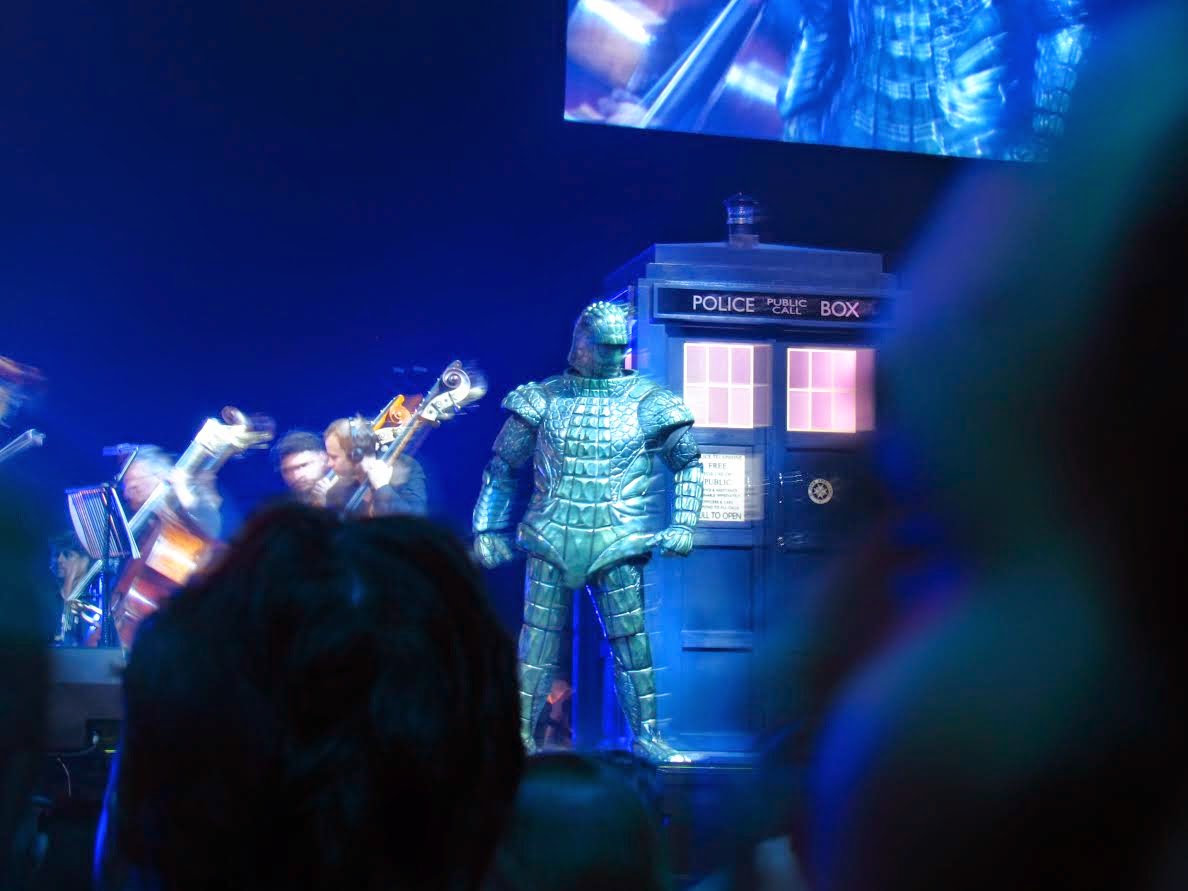
LIVE: Doctor Who Symphonic Spectacular


Review and Photos by Tom Newsom

The official concert based on one of the UK’s biggest TV shows has finally come to, er, the UK. After a couple of tours of Australasia, it’s now moved further afield - starting in London and then travelling to Cardiff, Birmingham, Leeds, Newcastle and Glasgow, cleverly timed for the May Bank Holiday and half term. And it’s a sell-out hit.

I was lucky enough to attend the show at Wembley on Sunday the 24th - which of course was packed with people. I’d watched the various proms from the past ten years before on the telly, but this was my first time hearing an orchestra play them live - in this case, the same BBC National Orchestra and Chorus of Wales that they use on the show (‘the house band’ as host Peter Davison calls them).

Did it go down a storm? Of course it did. A live playing gives the music so much extra energy and emotion, even in a massive arena. And I realised just how much emotion was contained in the music all over again: once it’s stripped from the words if not the visuals, the themes of the episodes and characters are majestic. It’s almost like seeing what’s in the writers’ heads before act structures and appreciation indexes, that raw Doctor Who feeling in all of us.

The set-list seemed very well chosen and skewed quite heavily towards the newest series - performed in these shows for the first time live, and released on CD a week earlier. I hadn’t heard the CD before the show, which meant that I was listening to a lot of the music for the first time away from the episodes. But what a series to go out on - lots of visual episodes, and music from nearly all of them were played. Plus this is the first concert since Peter Capaldi joined - and incredibly, he happened to be in the audience, watching himself and listening to the orchestra play his theme!

When you compare the new music to some of the older, more simpler themes (although the set-list doesn’t stretch back too many years), it’s like Murray Gold is writing the music now with this big, BIG broad sound in mind from the start. Because it’s the big orchestral numbers that are the stars here, especially the opening, which immediately gets the pulse racing.

If anything, it’s designed to be fun - lively talk between the pieces from the excellent host, nothing in the show that’s especially off-putting for children or first-timers (although monsters like the Foretold walking around can give you a fright!), and a whole lot of variety encapsulating light and dark, older and newer, traditional and a bit funky. And there’s slightly smaller but no less powerful pieces like those sung by soloist Elin Manahan Thomas. (Who knew that Missy’s theme had such beautiful words?)

And because of all this, it means it feels like it’s over far, far too quickly!

The Symphonic Spectacular, then, is aptly named. If you’re visiting in future, expect a big, incredible hit of Doctor Who music that will make you feel like a child again. It’s a pretty awesome event.


17 May 2015

FILM: Mad Max: Fury Road


review by Rob Manns

30 years after “Mad” Max Rockatansky battled his way beyond Thunderdome, he’s back with a new face and variable accent. Mad Max : Fury Road is a triumphant return to the big screen for the most iconic of Australian cinematic heroes.

Acclaimed director George Miller, now hitting his 70s, shows that age certainly hasn’t wearied him or dulled his talent. Fury Road is every bit as exciting, brutal and bleak as the original trilogy he brought us between 1979 and 1985. This time though, it’s also incredibly beautiful to look at. Ridley Scott once said that his aim was that you could pause his movies at almost any point and see a gorgeous, artistic photograph. Miller has achieved this goal with the help of fellow Queenslander, cinematographer John Seale. The gold of the desert sands and vivid blue of the skies create a unique canvas for the chaos to play out on. It is as beautiful as it is barren. I’m confident the Academy will agree come Oscar time.

Staying with Miller for a moment, the action scenes in this movie really need to be seen - on a big screen! - to be believed. Featuring the bare minimum of CGI enhancement, the spectacular stunts, human and vehicular alike, play out like a mesmerising ballet of chaos and destruction. Unlike most action directors these days, Miller lets you see everything that is going on. No epileptic editing and shaky cam here. This is how you do it right!

It’s not just the stunts though, it’s also the wild and weird characters the series is famous for.

Standouts here are the freaky War Boys and their monstrous leader, Immortan Joe - played by Hugh Keays-Byrne who also played lead villain The Toecutter in the original Mad Max. They are repulsive but you can’t look away. Like the landscape they inhabit, they are beautiful and terrible at the same time. Everybody’s favourite is the blinded guy who lays down some major heavy metal riffs on a flamethrowing guitar while tethered by a bungee rope to the top of a truck that also sports an enormous stack of speakers and a team of drummers. If that sentence doesn’t bring a smile to your face, you are dead inside. Dead!

And then there’s our leads. Tom Hardy is more than a worthy replacement for Mel Gibson. Bringing the same brooding intensity and toughness as well as the vulnerability. My only criticism is his seeming inability to settle on a single voice. His accent shifts around, a shame as he actually does a decent Strayan accent in the opening monologue, and Bane even creeps in here and there. The film, however, belongs to Charlize Theron as Imperator Furiosa, and her group of women she liberated from Immortan Joe. Furiosa deserves to become as revered as Ellen Ripley as a strong female role model. She kicks ass! All the main women in this film do, including the Many Mothers we meet late in the film. The most wonderful side effect of these characters  is watching MRAs having a big, manly sook about it.

How dare they put strong, competent female characters in a film about an icon of manliness, they say. But then, the whinger who started all of it also referred to the very Australian Mad Max series as a tentpole of American culture, so take from that what you will.

That’s all well and good, you say, but, what about the story? Story? You want all that and a story too? Have you ever seen one of these films? The plot is wafer thin but, where that is normally a weakness, it’s just another of this film's strengths. It really doesn’t need anything beyond a framing device for all the madness. Honestly, it gives you enough to allow the characters a motivation to get from point A to point B and that’s all you need or could want. Fury Road is best described as a 2 hour chase sequence punctuated by occasional moments of stillness to allow you to exhale.

Before I conclude this review, it would be remiss of me not to give a shout out to the incredible soundtrack by Junkie XL. It is just as important and impactful as the landscape and the amazing vehicles and punctuates the visuals perfectly with a mix of electronica, heavy rock and sweeping orchestral moments. Sure, there’s no Tina Turner power ballad but we can’t be greedy now.

So go see this movie on a big screen. See it now! All the gushing reviews you’ve read, this one included, are right. This is an unforgettable cinema experience. It’s the reason we have cinema in the first place and it’s brought to you by a true master of the art form. It’ll never replace Mad Max 2: The Road Warrior in my affections but it is probably the superior film, all things considered.


thanks very much to Rob Manns

13 May 2015

TV: The C Word


I've been putting off watching The C Word.

Luckily I've had lots of things to distract me but I still know that subconsciously I was putting it off.

Depending on how well you know me, you may or may not appreciate the impact a drama about a young woman dying of terminal breast cancer might have on me.

I'm going to keep this relatively brief as watching this was hard enough, let alone writing this. 

Essentially, I thought it was beautiful. It conveyed perfectly the rollercoaster that this kind of situation puts you in, for all parties involved. Sheridan Smith was predictably amazing, and Paul Nicholls never put a foot wrong as the lovely Pete, who reminded me of quite a few people.

This was excellently scripted and directed too. Stephan Pehrsson has been a director of photography whose work I've been following in admiration for a few years and delivers once again here. Nicole Taylor and Tim Kirkby show us a pair of beautiful people and these 90 minutes really broke my heart.

If I do have one criticism, it would be of the slightly overdone 'handheld' camerawork, wobbling about all over the place distractingly in quite a few scenes.

But yeah. I cried a lot at this. It was extremely bloody good. Sheridan Smith is just flawless. Watch it.